The inexorable march of time has once again made fools of us all, drawing another New England paddling season to a close despite our frequent mid-race assertions that "This duck-slapping debacle is never going to end!" Fortunately, Wesley had negotiated a one-week extension by dusting off an unused standby course in Narragansett Bay, re-christening it the Plum Beach Lighthouse Race, and tacking it onto the end of our schedule. Some might argue that we don't need a sixth competition in the Ocean State, but those people obviously aren't planning on running for state senate or taking advantage of Rhode Island's liberal paddler-in-residence grant program.
I figured Tim was lost in a moment of quiet reflection... until he started snoring.
Any hopes that the top regional contenders would skip a race so late in the season were ill-founded. Chris Quinn would be defending his recent Narragansett Bay win at the Jamestown Double Beaver. Recovered from an early season back injury, Mike Florio was back from his half-year hiatus, as fit and competition-hungry as ever. With Chris and Mike sporting the latest fashion in obscene muscle tone, the rest of us scrambled to change into loose fitting clothes. For the comfort and range-of-motion, of course. Well, everyone except Kurt Hatem's race-day alter ego, who wore only those ripped purple jeans he's so fond of (supplemented by some green body-paint). I'd put those three guys up against Thanos any day of the week. Particularly if it meant they'd be off fighting him rather than racing me.
The cast prepares for its ground-breaking presentation of Our Town.
As Wesley pointed out during the captain's meeting (with a little too much glee, I thought), my days atop the SurfskiRacing point series are numbered. He graciously omitted the fact that said number is already negative. Chris has beaten me the last three times we've raced. And it doesn't take much extrapolation of first-year paddler Kurt's season trajectory to see that he's going to be a serious contender for next year's crown. If Mike stays healthy, I expect he'll be crashing the podium regularly too. I welcomed change for the first few years of my surfski career, but with the wisdom of age has come the realization that we should probably stick with rerunning the 2016 season in an endless loop. Just in case my recommendation isn't approved by the committee, however, I sat the youngsters down and explained the changes that they'd be experiencing as they matured. It was about as awkward as you'd imagine, but better they hear it from a creepy old-timer than learn about it on the sea.
"He just never stops talking about paddling! Well, paddling and 15th century French composer Johannes Cesaris. I can't take it anymore!"
In addition to seasoned paddlers and bothersome upstarts, our 18 boat field included two open-water race virgins - Sam Duffield and Forrest Horton. With these youngsters joining us and (geez, Bill, I honestly feel terrible about this) Kuklinski a race-day scratch, I'm pretty confident our average age set a record low for New England surfski racing. Don't get me wrong - we still collectively qualified for an AARP discount at the restaurant afterward, but at least this time we had enough sharp eyes to read the menus for us.
Wesley explained the course to us. Starting just off the beach, we'd skirt marker G1 in the mouth of Wickford Harbor, pass outside of Fox Island, round the titular lighthouse (which, fortunately, is free-standing in the bay), and then retrace our steps back to the beach. For a race-weary field, the relatively modest 8 mile length may have been the primary reason for attending. Attired in such a varied array of shoulder-season outfits (ranging from shorts to drysuits, with outliers at either end) that our hypothetical spectators must have wondered if we were planning to scatter to the ends of the earth, we strode/waddled/clanged down the beach for our water start.
Wesley informed us that, regrettably, rather than racing he'd be starting on his unsupported trek to the North Pole.
We were off. Although there were several people still technically ahead of me, after adjusting for low start expectations, I had a substantial lead a hundred meters into the race. A half-kilometer later, the handicapped and "real world" orders were brought into agreement as I passed Wesley, Tim Dwyer, and Chris Chappell to move into the actual lead. There was some confusion as a paddler behind me shouted something about a rock pile up ahead. I immediately started evasive maneuvers to avoid crashing into the pile, cranking the tiller (a custom innovation I've been dabbling with) hard-a-starboard. Additional instructions from my unseen personal navigation system, conveyed now with the flagging patience usually applied to a dim-witted toddler, eventually made it clear that the rocks weren't an obstacle, but rather the base of our first turn - marker G1.
Progressing south after the turn, we gradually emerged from the wind shadow of the mainland. Although technically on a downwind leg, the short-fetch waves were more annoying than helpful. Occasional glances backwards revealed that Chris was hanging on my stern, with Mike several lengths behind him. We had been warned by Wesley not to skim too close to Fox Island lest we shear off our rudders. Although I was a good 50 meters off shore, native Narragansett paddler Chris had me second guessing whether I had provided enough clearance. He had veered off my stern and was now shadowing me half again further from the island. I kept waiting for the sudden grounding that would provide me with an unimpeachable excuse for losing this head-to-head, but I remained regrettably afloat [shakes fist at abstract concept of buoyancy].
Most of the way to the lighthouse, Chris remained back a couple of lengths on an outside line. As we neared the turn, he pulled closer and threatened to pass. Desperately wanting to be able to claim that at least I had led at the half-way point, I made sure (by signing certain dark covenants in blood) that I was the first to turn back upwind. Shortly thereafter, however, Chris pulled alongside and nosed ahead. Totally worth it, though. Did you hear? At the half-way point I was leading!
Rounding the lighthouse, we had a modest lead over Mike and Kurt. Definitely not enough to feel safe about. I'll be generous - both to Chris and to myself - and assume that Chris wasn't just toying with me as we paddled side-by-side back to Fox Island. Heading into a surprisingly stiff breeze, neither of us got more than a foot or two ahead before the other would counter and pull even again. This constant sparring certainly made the upwind slog more bearable, and probably helped to separate us from our pursuers. At Fox Island, however, Chris landed a few unparried blows and threatened to leave me behind. Woozy from all the blood loss (those contracts were in triplicate), I was tempted to throw in the towel, but managed instead to lunge onto his stern draft and cling there while the ref tried to separate us.
It seemed highly likely that if we stayed in this configuration until a final sprint that Chris would take the win. I was perfectly willing to take that chance and maintain the status quo for the next couple of miles. Why rock the boat? Chris apparently didn't subscribe to this philosophy. He seemed intent on shaking free of my clutch immediately. Over the next mile, he threw in random bursts of speed, which I was just barely able to counter, thanks to his significant drafting (water and wind) disadvantage. With a half-mile to go to the G1 marker turn, Chris finally appeared to resign himself to my original plan - beating me in the sprint after the turn. As we slowed to a brisk canter, I felt the satisfaction of a cowboy who has just broken a wild stallion. Until I realized that I'd soon have to dismount and race the damn horse on foot.
No surprise - as we completed our turn, Chris charged pell-mell towards the finish. Before I could hit my own stride he had already pulled 3 boat lengths ahead. I had held out some hope that the calm waters in the lee of Poplar Point would provide me with a slight edge. In retrospect, I'm not quite sure why I would have entertained that notion. For a brief moment, I thought I might be closing the gap, but it soon became clear that there was a new status quo. I finished about 10 seconds behind Chris, yet it somehow still felt like a definitive thrashing. Kurt pulled in a few moments later to take the final podium spot, with Mike and Tim claiming 4th and 5th positions. Mary Beth was the top woman. As she always is, of course, in my book (I've found that if you butter up the editor a little, she'll ease up a bit on the pun-shaming).
PaddleGuru's Clipboard App offers state-of-the-art race timing. Probably should've sprung for the water-resistance upgrade, though.
In a fitting piece of symmetry, we jaded vets celebrated the season-ending race at the Oak Hill Tavern - the same venue that hosted our pack of wide-eyed innocents after the season-opening Narrow River Race. Book-ending the library of New England races in this delightful manner felt so much like the inception of a time-honored tradition that I've already started pestering management to add a "Surfski Special" menu item. They're willing to consider it if Wesley and Tim get "Oak Hill" neck tattoos and the rest of us commit to 20 years of patronage. Done!
Feels like I might have one more good race in me this season. Since I'll be paddling in it anyway, sure hope it's the Chattajack 31.
Helmed by force-of-nature Gary Williams, the Lighthouse to Lighthouse Race is the place to be to rack up your worst finishing position of the New England season. With significant prize money (donated by PTX Partners and Stellar Kayaks), a location that's easily accessible from much of the northeast, and a beautiful course with as many as two scenic lighthouses, the L2L consistently boasts a broader and more talented field of surfski paddlers than any other regional race. Since 2014, the race has also served as the East Coast Surfski Championship.
Mary Beth and I inadvertently picked up Bill Kuklinski on the drive down to the race. You never think it'll happen to you, but by the third or fourth time, maybe you should. Banned from paddling in Connecticut after last year's unfortunate "Nutmeg this!" incident, Bill had to go to extreme measures to thwart the authorities - having his boat delivered separately across state lines by an unsuspecting chump. Ryan Bardsley's wide-eyed naivete made him the perfect mule, but an irrational loyalty to his mechanically-challenged Volvo threatened to jeopardize the plan. Fortunately, he managed to limp into the Norwalk Hilton parking lot before his car gave up the spöke. Through clever re-purposing of our downwind shuttle expertise, we were able to reunite Bill and his boat on the beach. When last we saw Ryan, he was still on the phone with Stockholm, trying to arrange a trade-in for a Saab.
The sea was indifferent that day, my friend.
The L2L typically draws at least a couple of elite paddlers to remind the rest of us what's possible in this sport. This year, Ian Black (South Africa) and Nate Humberston (Florida) would be there to expand our horizons (which gives us a few more seconds to witness their speed). Erik Borgnes (Wisconsin) provided a slightly more realistic template for paddling excellence - many of us could at least aspire to be roughly his age. Many of the best northeast paddlers made it to Shady Beach as well, including guy you want to befriend on your first day in prison, Craig Impens, first-year ski paddler Bob-Rob Jehn (I never quite caught which name Robert preferred), perennial thorn-in-my-side Jan Lupinski, and terrifying robot dude from Westworld, no not the new one, the 70's movie, Chris Quinn. I expected Matt Drayer, John Hair, Joe White, Gary Wade, Kurt Hatem, Rowan Sampson, and Tim Dwyer might also be in the hunt for the top 10. It was going to be a day of exciting duels.
A week and a half earlier, an excited text from Matt alerted me to a race-day forecast of 25 knot winds from the East. I'm not sure what the world's coming to when you can't have absolute faith in a meteorological prediction 10 days out, but this Orient Express scenario got derailed well before reaching the L2L. The morning of the race, the forecast stood at easterly winds of 2 knots. With gusts to 3! Looking over the glassy expanse of Long Island Sound, however, even that projection seemed tempestuous in comparison.
I've included so many photos of Timmy in past reports that he's now started showing up in my blog uninvited.
As many of us unfortunates were to discover, John's changing tent would have been a lot more effective without the peek-a-boo flap.
Starting adjacent to Shady Beach, we'd round Sprite Island, pass Peck Ledge Lighthouse, skirt the shallows of Goose Island, work our way down past Copps and Sheffield Islands, turn on Greens Ledge Light and retrace our path (give or take tide-based adjustments) back to the start. Although billed as a 14 mile race, recent cutbacks have reduced the actual length to 13.3. Something to do with Chinese tariffs, I'm told. Of course, a few traditionalists stubbornly padded their mileage to hit the full distance. Mary Beth, for example, cut inside of Goose Island on the way back, realized her mistake at the lighthouse and then backtracked around the island.
As usual, Gary really nailed the captain's meeting - providing step-by-step instructions on performing an emergency field tracheotomy. Who knew all you needed was a clean handkerchief, a disposable pen, and a hatchet? Now that I think of it, I may have been watching a YouTube how-to video on my phone. I'm sure Gary did a swell job, though (Goose Island cutters notwithstanding). And if he didn't... well, I'd be prepared for any eventuality. Well, for one eventuality, at least.
Gary's running commentary on the state of the lighthouse beacon got a little monotonous after the second hour. (Photo courtesy of Olga Sydorenko)
Nobody had the heart to tell Wesley that his parachute was on backwards. (Photo courtesy of Olga Sydorenko)
Before I even had time to practice my new-found skill, it was our turn to launch. I positioned myself at the far right of the starting line - a strategy I used with some success the previous year. This allowed me to bypass the barbarous fray of the main pack, but more importantly, it also artificially inflated the consequences of a poor start. With the first turn marker only a half mile away, if I didn't manage to get ahead of most of the other paddlers quickly, I'd be forced to merge into a stream of unforgiving rush-hour commuters to clear the buoy choke point. Spurred on by this incentive, I popped off the line with unaccustomed vigor. Nate and Ian separated almost immediately from the huddled masses, with Craig, Bob, and Erik in spirited pursuit.
A couple of hundred meters from the turn buoy, I angled into the thinning herd, hoping they'd accept me as one of their own. A snide comment from Matt before the race regarding the ripeness of my gear assured me that at least they'd already be familiar with my odor. I pulled alongside John, who in turn was paddling abreast of Gary, Chris Q, Jan, Tim, and Nick Alshayev. This group jostled for position as the orange marker loomed closer. A lone voice of civility among murderous savages, John sweetly reminded us that "We're all friends here, right?" If that were the case, you'd expect at least some of the guys would unblock me from Instagram. Powered by a burst of righteous indignation at this imagined slight, I pulled a half-length ahead of my "buddies" and rounded the buoy with a clear conscience. Given that the turn consisted of a 16 degree deviation from a straight line, however, arriving there in our gang's pole position didn't actually provide much of an advantage.
Roger and Scott surfed their extreme age gradient to victory. (Photo courtesy of Olga Sydorenko)
In any event, now only Joe separated me from the chase pack. A few weeks earlier at the USCA Nationals, Joe never failed to provide cheerful encouragement as we passed each other at the turns. In keeping with this supportive trend, he now complimented me on my start and urged me to move now to avoid having to play comeback later. What game was the Ohioan playing at? I suppose it's possible that he's just an all-around decent fellow. Or that John's plaintive plea for sportsmanship and camaraderie had softened his heart. But in the cut-throat, high-stakes world of the East Coast Surfski Championship, it seems most likely that Joe figured that by egging me on in my quixotic quest to break the top 5, he could catch a ride up to the pursuit team, then watch unblinkingly as I imploded and fell off the pace. Yep. That sounds exactly like something the Joe persona I've contrived would do. Still... seemed like good advice.
Nefarious Joe earned his newly coined nickname. (Photo courtesy of Olga Sydorenko)
A quarter-mile later, we caught the paddlers ahead. Bob was pulling, with Erik on his left flank and Craig on his right. I settled in behind Craig, figuring that after a moment of rest I could slide forward into the sweet spot of a diamond formation behind Bob. However, I couldn't get comfortable enough on Craig's stern draft to relax my effort. In retrospect, the wakes from the other members of the trio were probably harshing my mellow - I should have immediately either moved into the diamond or shifted to Craig's starboard draft. Instead, I grew increasingly frustrated at how much effort it was costing to keep up with the trio. I took some solace in the fact that Joe had finally fallen off my draft, although the appearance of an Epic prow in my periphery (Chris Q? Gary? Kurt?) soon wrenched away that short-lived consolation.
Craig and I had been rehearsing our respective roles for years, so I was caught off guard when he decided to improvise. In the standard production, he takes the early lead in the pairing, relinquishes it reluctantly after a couple of miles, lets me get a reasonable distance ahead, then slowly reels me back in during the back half of the race. To keep the audience guessing, we draw straws beforehand to see if he'll catch me or not. But by this point, Craig had long ago missed his exit cue and was continuing to showboat shamelessly. Try as I might to get him back on script, he refused to yield the stage.
After clearing Goose Island, Erik broke from the pack to forge a future for himself on an outside line - presumably searching for a little more tidal current. I took this as my cue to also fly solo in clean water, setting up shop halfway between Erik and the others. Demonstrating an admirable (but unwise) degree of dedication, my mystery drafter stuck with me. After a mile or so with little change in our relative positions but a significant change in my heart rate, I swung back to draft Bob and Craig. I held on for perhaps another mile before gently slipping off of Craig's stern wash. I had been officially demoted to a supporting role in our latest performance.
I soon discovered the identity of my long-time companion. Chris Q had thrashed me soundly several weeks earlier at the abbreviated JDB race. Ever since then, Tim Dwyer has taken a perverse glee in telling me how haphazard his young protege's training has been. As Tim is constantly reminding me, Chris puts in long hours with the family business, lifeguards, and has two young children, leaving him little time to paddle. And yet here he was, threatening to once again... hold on, someone at the door. I'm back. Singing telegram courtesy of Tim. The Mighty Quinn. Real original.
When asked why he insists on paddling in the nude, Chris responded that he "didn't want to waste all that shaving." (Photo courtesy of Olga Sydorenko)
Erik eventually rejoined Bob and Craig, the three of them gradually separating themselves from Chris and me. By the time we reached the end of Sheffield Island, the trio were perhaps 20 lengths ahead. They appeared to be splintering, with Erik taking a surprising inside line and Craig pulling ahead of Bob. The mile between the tip of the island and the turn-around at Greens Ledge Light was inexplicably lumpy. The faint easterly breeze that had previously been providing us with some wee runners hardly seemed up to the task of firing up the frothing mayhem that lay before us. OK, so perhaps there was no froth (excepting the stuff bubbling out of my mouth) and "faint commotion" may be a more accurate descriptor than "mayhem". But the fact remains - the conditions seemed incompatible with the virtual absence of wind. For the first time of the day, I was glad I was safely ensconced in a V10 rather than balancing precariously on my V14.
On the way to the lighthouse, Chris (who was now ahead) and I gained significant ground on Bob, who finally appeared to be flagging. Erik returned from his exploratory mission, rounding the lighthouse slightly ahead of Craig. As Chris and I turned for the voyage home, it seemed inevitable that we'd catch Bob. We were getting closer and closer until... we weren't. I don't know if it was getting out of that wobbly stretch or if Bob tapped into a reserve power source, but our gains of the last fifteen minutes were quickly reversed. This latest setback was a real kick to the morale. I had been leading Chris since shortly after the lighthouse, but now he pulled ahead for the last time.
Was I the only one concerned by how excited Tim was about his new ski? (Photo courtesy of Olga Sydorenko)
The remainder of the race was uneventful. I refused on principle to follow the ridiculous shore-hugging line that Craig, Bob, and Erik pursued among the islands to duck out of the tide. That doubtless set me a few more seconds back, but at least I maintained my Euclidean integrity. My initial goal of keeping Chris within a stone's throw gradually relaxed to the point that I'd be ecstatic if he stayed within 3-iron range - and, believe me, I'm a champion club hurler. In the end, Chris finished about a minute ahead of me to take 6th place.
Nate wraps up his 14 mile clinic with flair. (Photo courtesy of Olga Sydorenko)
Up at the front, Nate had beaten Ian for the championship, with Erik in third. Bob made a strong final push to challenge Craig for 4th, but fell 20 seconds short. After Chris and me, Kurt Hatem (continuing to impress in his first season), Matt, and Gary rounded out the top 10. On the women's side, newcomer Melissa Meyer outlasted Leslie Chappell for the win, while Mary Beth eventually discovered the correct course by trial-and-error navigation to finish 3rd. Roger Gocking and Scott Visser took the doubles crown, while the SS20+ titles were landed by John Costello and Jean Kostelich. Ian and Mary Beth took the Stellar-sponsored hot spots. Congrats to all the worthy finishers! And also (as joke convention compels me to add) to Bill (sorry, buddy - seems like a lousy thing to do to the guy who's served admirably as the target of so many digs)!
While none of the local men landed a spot on the podium, Bay Staters swept the women's awards. (Photo courtesy of Olga Sydorenko)
While I realize that 7th place is nothing to sneeze at given the depth of the field, I couldn't help but seethe in self-loathing while stuffing burgers and dogs in my froth-hole after the race. Why, oh why, couldn't I just shave 20 years from my age? Actually, better go with 30. At least then I'd probably be off singing along to Enya or playing D&D rather than being beaten at a dumb kayak race. Maybe next year.
Many thanks to Gary and his team of dedicated volunteers. You guys threw yet another humdinger!
Next up is the Glicker Downwinder on October 6. Register at PaddleGuru. Hope to see you there. That is, if you're there, I hope that - unlike last year - I can actually see you.
If you're a New England paddler and you don't have a signed excuse from your doctor or your congressman, you're pretty much self-obligated to attend Mike McDonough's Nahant Bay Cup - the final regional race before Labor Day rolls in and puts the kibosh on summer. Despite missing a few regulars (still waiting on those notes, guys), a healthy crew of 18 paddlers made the arduous trek to Fisherman's Beach in Swampscott - a town so notoriously difficult to get to that it wasn't actually discovered until 1973. And yet, somehow, parking is still a problem. I spent a good chunk of the mandatory pre-race socialization period talking with first-time participant Peter Lacoste. Try as I might to maneuver the conversation in this direction, I just couldn't get the Australian expat to say something funny about a dingo. Maybe next time.
Mike soon called us together for the skippers meeting, leading off with a heartfelt dedication of the race to Jim Gilligan - a beloved local paddler and all-around class act who passed away unexpectedly a couple of weeks earlier. One of my favorite memories of Jim is of him excitedly explaining how he was going to resolve stability issues with his new Huki S1-X by fitting 20 pounds of shaped lead weights into the footwell. That may make him sound like less than a serious paddler, but this is the same competitor who broke 3 hours in the Blackburn paddling a Mako XT just a few years back.
Jim Gilligan at the finish of the 2011 Nahant Bay Cup.
Although Mike often adjusts the course to accommodate the conditions, this year we'd be running the "classic" course (well, maybe "neoclassic" would be more appropriate) for the first time since 2015. We'd cross Nahant Bay to turn on a red buoy shortly past East Point, skim across the mouth of the bay outside of Egg Rock, round Off Rock, skirt Dread Ledge, and return to Fisherman's beach for an onshore finish - a total of 9.5 miles. The initial leg would be into a moderate headwind, the second leg would be a mild downwind (The Disappointment of the Out-and-Back Paddler - good title for an autobiography), and the final leg would include a grab-bag of conditions and a hull-tearing reef. Of course, it wouldn't be the Nahant Bay Cup if these directions weren't relayed by Mike exclusively via a pantomime of dramatic gesticulations.
Everyone thinks he's an expert...
...but there's only one true master.
Before the race, Mike had proudly showed off an antique brass contraption consisting of a pump and a trumpet-like bell. Needless to say, I was appalled. Having read my Harry Potter (to the, uh, orphans), I recognize a Soul Snatcher when I see one. As Mike made to demonstrate the ghastly apparatus by plunging down the handle, I sprang into action. Fortunately, it turned out to be an old starting horn for yacht races. Mary Beth, grown accustomed to my inexplicable behavior over the years, didn't blink at having been thrust in front of me just as the horn sounded. Which is good, since it allowed me to quickly check her eyes. Whew. Soul intact.
I knew that Jan Lupinski couldn't pass up a chance to defend his Nahant Bay crown. After getting off to a good start this season over an admittedly under-trained Jan, we've split our last four head-to-heads. We're so familiar with each other's strengths and weaknesses that there's barely a reason to actually race one another. Given details on the course and conditions, we just plug the numbers into the Leshpinksi Algorithm and voila... no need to actually suffer. Of course the head-to-head outcome doesn't indicate the overall champion of the race, but as long as I beat Jan on paper, I'm okay with taking a DNS. However, the particular circumstances of this race led to inconclusive results - the flummoxed algorithm just kept spitting out Toto lyrics. Looks like we'd have to settle this the old-fashioned way. Now imagine Jan saying "on the water" and me saying "coin flip" at the same time. Masochist.
Honoring the long-standing nautical traditions of Swampscott, the Nahant Bay Cup is the only race on the New England calendar that still features live semaphore translation.
I didn't have the heart to tell Mike, but the starting horn was something of a disappointment. Based on his quarter-effort demo, I figured the full-throated roar of the horn might have the more pious residents of Swampscott doing some last-minute rapture prep. Instead, I found myself waiting for someone to excuse themselves as the modest toot wafted over the starting area. By the time I realized my mistake (pardon me, by the way), Jan, Andrius Zinkevichus, and Chris Chappell had jumped out to an early lead. With Matt Drayer in tow, I chased after them through the mooring field, barely dodging a number of deceptively stationary boats. A few minutes into the race, Jan separated himself from the (fraternal) twin 550s of Andrius and Chris. Shortly after, I passed Team Nelo. They slid over and joined Matt, but the trio never quite managed to catch my draft. Over the next couple of minutes, I approached to within a couple lengths of Jan. Not wanting to spook him (or, possibly, not able to close the final 40 feet), I hung back in this position.
About two miles into the race, I was startled by a abrupt shift in balance as my footplate slipped a notch on the left side. This had happened once before in our Tuesday night Salem League, so I wasn't overly alarmed after recovering from the initial surprise. The skewed footplate made it slightly more difficult to turn left, but nothing I couldn't compensate for. I continued shadowing Jan, staying back a few lengths in the hopes that he'd forget about me and decide to take a nap. Entering the more confused waters around East Point, Jan stayed further out while I kept closer to the rocks hoping to find some reflected waves heading my way. Traffic was light in that direction, and few were keen on picking up a malodorous hitchhiker, but I did manage to close to within a length of Jan by the time we reached the buoy. My gains were short-lived. Jan's lead sprang back to three lengths almost immediately after we both had swung our noses downwind, then continued to stretch as he more effectively exploited the small runners. I saw Matt, Andrius, and Chris make the turn perhaps a minute behind me, but was unable to identify the subsequent paddlers.
Although I hadn't initially been too concerned about my footplate, in the downwind leg it became an annoyance. More importantly, it was a minor mechanical issue, the resolution of which I could pin extraordinary and unwarranted expectations on. Surely the slight compromise in my steering was the only reason Jan was pulling inexorably away! Although you don't need tools to adjust the Epic footplate, I'd had some expletive-laden difficulties in the past getting the mechanism to slide freely after disengaging the spring-loaded detentes. Even standing on dry land with the boat in a sling, it's 50/50 whether I'll manage to stay upright while making the adjustment. Remarkably, I managed to shift the plate back into position with just a quick tug. I was underway again almost immediately. However, if there were benefits to be reaped from this repair, they weren't immediately apparent. Over the next couple of miles, Jan continued to increase his lead. In contradiction of the algorithm output, turns out it wasn't gonna take a lot to drag me away from him.
You certainly wouldn't characterize the downwind conditions as "ripping" - or even "mildly entertaining" - but we were being helped along by a steady stream of wavelets from a selection of directions. You had to work for each little bump though. Although the temperature was only in the 70s, the interval-like efforts and the lack of apparent wind combined to make the trip to Off Rock increasingly uncomfortable. Additionally, the sea had that glassy sheen that adds a good ten degrees to the perceived temperature. I hypothesize this is because the smooth parabolic concavities focus the sun directly on your head from every conceivable angle, but that just might be the ravings of a man suffering from wave-concentrated solar energy brain damage. It was difficult to maintain a commitment to chasing down Jan, but having built up a head of steam, I didn't want to waste it.
Given that Jan's guidance software has been glitchy for as long as anyone can remember, I couldn't tell if his meandering up ahead was due to imperfect targeting or if he was aggressively chasing off-angle runners. In any event, it felt like I was able to staunch the bleeding by taking a more direct line towards Off Rock. Perhaps a minute before I reached it, Jan rounded the rocky island with what seemed a generous berth. In an attempt to shave his lead, I risked shaving my rudder by gingerly feeling my way around the shallow verge. I made it around unscathed, but not for lack of trying. Somewhere in the world, a glacier gave its life to provide me with those 2 extra inches of clearance.
We had approximately a half-mile of forward quartering seas before reaching Dread Ledge and heading back into Nahant Bay. This deep into the race I figured that I had the flatwater speed advantage over Jan, but the conditions were slightly too confused for me to hammer efficiently. I could still flail sloppily, however. Rounding the ledge with a mile of paddling left, I was back perhaps a half minute. With only relatively smooth water separating us from the finish, that old devil, optimism, started whispering in my ear that with enough pain, I could take this. Like a sucker, I bought a jar of this snake oil. Turns out it was half-empty. Jan ran up the beach to beat me by 13 seconds. Matt rolled in a few moments later to take third. As additional paddlers completed the course, we gathered to anxiously await everyone's favorite Swampscott spectacle - Francisco's jubilant drum-major-on-speed high-stepping dash across the finish. He didn't disappoint. Mary Beth took the women's title, although with considerably less panache.
Nobody knew who this was, but he kept asking if anyone had seen his pony.
Kind of a stickler for safety, Mike insisted that we wait until every single paddler was accounted for before allowing us to dig into a spread of watermelon pizza salad and cookies. Maybe he should worry a little less about boats being lost at sea and a little more about missing punctuation. Once we had sorted out the comma fiasco, the food really improved. After the medals were awarded, Dave Grainger was rightfully knighted into the Order of the Bad Ass in a solemn ceremony. Mike was a little wild with the non-dubbing paddle blade, but fortunately all wounds were superficial. As an OBA, Dave is entitled to use whatever-the-hell honorific he chooses. I'd probably go with Overlord Grainger, but it's his call. For Ryan Bardsley's quick rise to prominence (and unfortunate propensity for standing behind Mike during dubs), he was fitted with the Helmet of Promise. Don't let it go to your head, Ryan - Bill Kuklinski held this traveling trophy before you, and, quite frankly, we're still waiting for him to blossom. Thanks to Mike, Carol, and assorted other family members for a superb day.
The champs, the Bad Ass, and that guy with a helmet.
Summer may finally be burning itself out, but the New England surfski season isn't taking the hint. Even though it's on the placid Merrimack River, the Great Stone Dam Classic has become one of the largest ski races in the northeast. It's also now a part of the SurfskiRacing point series. That's on Sunday, September 9. You'll then be primed for the East Coast Surfski Championships at the Lighthouse to Lighthouse the following weekend (September 15). Register at PaddleGuru.
Once again, the Battle of the Bay fell within the mandatory blog blackout period following the Gorge Downwind Champs. However, I'm assured that the Committee often turns a blind eye to brief race summaries provided that they "portray surfski paddlers in a positive light" and avoid ancillary alliteration. Hardly seems worth writing anything under those conditions, but here goes.
While last year's race was hastily reorganized to a rip-roaring downwinder, with modest wind conditions we'd be reverting to a course similar to 2016's. You may recall this as the route so distasteful to Jan Lupinski that he instead created his own alternative course, persisting for two laps even when it became obvious that nobody was following his lead. From the dock of the Conanicut Yacht Club, we'd head out around buoy G11 near the House on the Rock, retreat up the bay to a stanchion of the Newport Bridge, return to G11, and finish back at the Yacht Club. Assuming no detours, this would be about 6.25 miles.
Wesley really took Sean's recommendation to "keep his arms up" to heart.
I knew it. They're pod people!
Attracted, no doubt, by the prospect of humiliating post-race novelty costumes, Sean Rice once again joined the Battle of the Bay. To help cover his expenses, he also scheduled a few clinics and private lessons in Jamestown. As in previous years, Sean would provide us with a sizable head start, then blow by us mid-course as if we were moored.
After the first wave start, Chris Laughlin and Jan quickly took the lead on an inside line. Hoping to catch some of the outgoing tide, I stayed further out initially, but quickly revised my tactics and angled over to join the leaders. By the time I caught them, Jan and Chris had switched places (but, showing little imagination, had remained in their own boats). I pulled onto Jan's side wash, then slid back to his stern as Chris dropped off the pace. We remained in this stable configuration, bucking a moderate headwind, until arriving at G11.
I had assumed that Jan would pull away during the subsequent downwind leg, but surprisingly I was able to maintain contact as we both enjoyed some decent runners heading toward the Newport Bridge. With our speed matching that of the wind, the warmth and humidity of the day became increasingly apparent. I was just starting to build an unhealthy dread of having to duel Jan for the remainder of the race in these muggy conditions when I unexpectedly caught and passed him. At first I figured that I must have surged ahead on a fluke run, but as I continued downwind to the turn-around abutment, I realized that Jan had fallen well back. As it would turn out, he had imploded in the heat.
Presenting a strong finish requires perfect synchrony with the photographer. (Photo courtesy of Olga Sydorenko)
Sad Jan makes me question the existence of God. (Photo courtesy of Olga Sydorenko)
I spent the remainder of the race awaiting to be passed by the one-man second wave. Of course, I wasn't disappointed. With a half-mile to go, I spotted Sean overtaking me on an outside line. He would ultimately beat me by 8 minutes in what was for him only a 45 minute race. So I still have a little room for improvement. Jan would finish third with hard-charging Kurt Hatem (who had overtaken a heat-flagging Chris on the final leg). Mary Beth nabbed the top women's spot.
Despite years of studying their ways, Greg could never truly pass as human.
The remainder of the day was spent grabbing lunch at Spinnaker's, watching boats from the cliffs of Fort Wetherill (hold on a second - is that Kurt doing out-and-backs after racing in the morning and then attending Sean's afternoon clinic?), and enjoying a lively group dinner at Tim's. The next day we'd again get schooled by Sean, this time in his all-day clinic. Thanks to Tim and Alyce for hosting the festivities and to Sean for slumming it with us in good cheer.
I still can't paddle worth a damn, but my rotator cuff was miraculously healed. (Photo courtesy of Olga Sydorenko)
For the 11th running of the Jamestown Double Beaver, race director Tim Dwyer decided to mix things up. No longer married to the "Jamestown", "Double", or "Beaver" parts of the name (the last two elements referring to the two passes by Beavertail Light), Tim briefly considered cutting all ties to the past by running it as a sled dog race. It was only after his wife patiently explained to him what "doggy paddle" actually meant that he decided to stick with humans. He did, however, migrate the venue to mainland Rhode Island (huh?) and shift the start time to late afternoon to maximize our chances for a downwind run.
While the wind did materialize, it brought along some unwelcome guests - lightning, rain squalls, and a newly-bald Chris Quinn (looking disturbingly fit). In the hour leading up to the start, the visuals to the north grew increasingly ominous, with a rumbling soundtrack designed explicitly to amplify our dread. Attempting to salvage a reasonably safe race, Tim cycled through course adjustments with wild-eyed fervor. From the original 9 mile triangle course, we progressed through countless variations before finally settling on a 5.5 mile sprint for survival. From our starting point at the University of Rhode Island (Go Quahogs!), we'd head up Narragansett Bay to turn on an abutment of the Jamestown Bridge, then return back to the start.
Only those paddlers categorized as "expendable" were allowed to compete this year.
Perhaps because of the dire forecast, turn-out for one of New England's signature races was uncharacteristically low. Once we shooed away all the huskies, I mean. Only ten of us showed up, with one gentleman opting out after deciding that a 17% chance of electrocution was too high a price to pay for the chance at Double Beaver glory. Tim sweetened the pot by offering to rename the next year's race in honor of anyone finishing in a literal blaze of glory, but that only resulted in the vainer of us affixing make-shift lightning rods to our PFDs.
Lining up for the start, the reason that Chris had shaved his head became obvious - he alone wouldn't have to deal with the distraction of his hair standing on end. I said he alone. Wanting to give us as much of a safety buffer as possible, Tim quickly counted us down to a start. Although the first leg wasn't a paddles-down kind of downwind, there were some decent waves to work with. Dave Grainger took advantage of the conditions to launch out of the gate looking strong, as did Tim and Wesley. A couple minutes into the race, I moved to the front of our increasingly spread-out group. This lead would last for about 90 seconds before Chris caught a nice series of runners and pulled ahead.
It took me the next half-mile to figure out that this was the new order of things. I wouldn't be able to catch him on the downwind without wiping myself out for the return trip. I resigned myself to just trying to hang in his general vicinity until the bridge and then, er... paddling better? Shortly after this ego recalibration, I heard Tim yelling something from behind. A surprising amount of yelling goes on during our races, most of which I've found can be safely ignored. An element of panicked urgency in Tim's voice suggested that I might want to pay attention, however. Upon tuning in, I discovered that he was amending the course yet again - perhaps to avoid the finale of the fireworks show that I had been hearing just over the horizon. Rather than turning on the bridge, we'd round a moored boat just a couple hundred meters ahead. The fact that it was necessary to relay this message to Chris didn't reflect too well on my efforts to hang close to him. He took the turn about 10 lengths ahead.
I didn't like my odds catching Chris by honorable means, so I decided to throw my lot in with the outgoing tide while he hung closer to the coast. In the face of inevitable defeat, it's important to start lining up rationalizations as early as possible. This desperate measure would at least provide me with a flimsy "bad line" excuse for getting so soundly beaten. So here it goes... By keeping better tucked out of the wind rather than foolishly trying to exploit a meager tidal current, Chris extended his winning margin from 55 seconds to a full minute. Tim held off Kurt Hatem to claim third. The final course clocked in at just over 3.5 miles with the winning time measuring well under a half hour. Chris' first surfski win was a convincing one. What better time to retire from the sport than while on top?
The photographer refused to take the picture until Tim and I had put our shirts back on.
Mary Beth's win in the female division merits some additional coverage. In a scant field with less speed diversity than usual, she had fallen off the back of the pack. As a result, she neither heard about the route change nor saw anyone make the abbreviated turn. Famously, the same thing happened in the 2013 Double Beaver, where MB alone completed the original course. As the lawsuit to have her instated as the official champion of that race drags into its fifth year, this year's repeat fiasco can only bolster her case (the term "depraved indifference" seems likely to sway a few jurors). Fortunately, this time Mary Beth figured out that everyone else had turned early, even though she didn't know exactly where. Picking an arbitrary point well beyond the actual downwind terminus, she ended up paddling a 4.25 mile course. The excess will be credited to next year's race. Additionally, Tim has decreed that all future Double Beavers must include a designated Course Adjustment Specialist assigned to apprise Mary Beth of the latest route alterations. As the person most likely to have to inform her parents should she be lost in Narragansett Bay, I suspect I'll have to volunteer.
Mary Beth reacts to being informed that, once again, she's been DQ'ed for course augmentation.
Tim's decision to shorten the course exactly when he did makes me think he's either a meteorological genius or a spooky clairvoyant. In any event, the timing of the event worked out perfectly. We tried out the new Stellar SEA that Dave Thomas had brought, stowed our boats, did the awards and the prize drawings, and were just finishing our pizza dinner when the skies opened up and deposited a swimming pool's worth of rain on our beach. Fortunately, we could see the wall of water approaching across the bay, giving most of us time to avoid the deep end. Thanks to Tim (and to prize sponsor Epic) for a brief but memorable race.
Mike McDonough's Nahant Bay Cup is this coming Saturday. There's no need to sign-up beforehand - just register at Fisherman's Beach in Swampscott between 8:30 and 9:30 for the 10 o'clock race.
[Note: Despite my jokes about the storms, we had forecasts and live radar indicating that the action wouldn't reach our locale until well after we had completed our appointed rounds. In fact, even though it eventually rained at the venue, we never experienced lightning in the immediate area. In summary, we're something short of suicidal maniacs.]
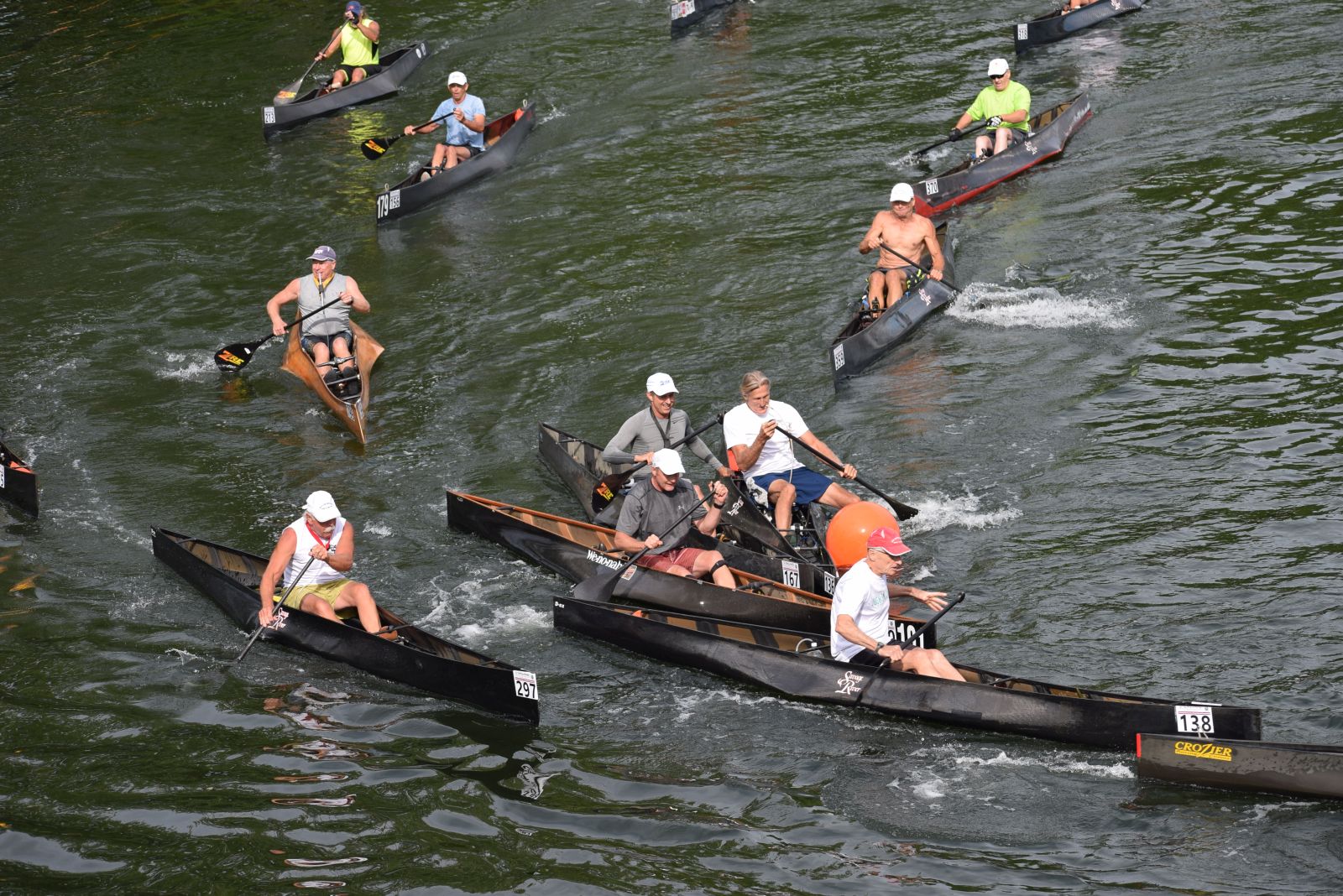
The USCA Nationals offer an opportunity for flatwater canoeists and kayakers to set aside their differences for four days to compete in harmony at a shared venue. All races are within group, of course - there's a limit to how much comingling can be tolerated. Like the better circuses, the Nationals are constantly on the move to stay one step ahead of the law. This year's edition took place at Onondaga Lake State Park in Syracuse. Most famous for dissolving flesh from bone, spurring runaway tumor growth, and giving you four varieties of dysentery, the EPA recently declared the lake "mostly water" after a multi-year cleanup effort. Fortunately, we wouldn't be paddling anywhere near ground zero of the Superfund site.
Onondaga Lake drains to the Seneca River via the half-mile Lake Outlet, the two waterways meeting at a T punctuated by a large island. Our 12.5 mile race would consist of two laps (and change), each lap consisting of a counterclockwise traversal of the T with 180 degree buoy turns at the, uh, serifs. So we'd have to negotiate a total of six left turns during the race. Since the park fronts the Outlet, spectators would be able to watch the start, half-way turn, and finish of the race. Although there were no shallows, those of us with rudders had to contend with weed beds when attempting to duck the current near shore.
Mary Beth dueled for much of the race with Courtney Rudder, beating her by 13 seconds in the end.
On Friday, I got a chance to scout the course by proxy as Mary Beth competed in the women's Unlimited K1 event. She had an excellent race, emerging as national champion in her age group. And, more importantly, she was able to provide valuable intel on current, weeds, and carcinogen pockets. Joann Hanowski edged out Eileen Visser as the overall winner. In men's unlimited K2, Matt Skeels and Jim Mallory cruised to an easy victory in their ICF boat. Imagine a dignified dog of a certain age (say, 8.5) who just wants to live his life in peace. And then imagine a mischievous whelp who won't stop playfully biting the elder dog's ear and cracking jokes about how old he is. That's the delightful Mallory-Skeels dynamic. Seems to work for them. In men's touring K1 (which has apparently now expanded to include the V10 Sport), ageless Mike Herbert powered his S18S to squeak out the win. OK, at a 9 minute margin, maybe more of a roar than a squeak.
The comedy team of Jim and Matt led the Unlimited K2 race from start to finish, in no small part because they were the only team with a well-defined schtick.
Saturday's Unlimited K1 roster was imposing, to say the least. Matt, Jim, and Mike would be racing again, of course. They'd be joined by Erik Borgnes, Craig Impens (who had competed in a C2 with his father on Friday), and Jan Lupinksi - not to mention the many unfamiliar paddlers who might also contend for the title. I'd never beaten Erik or Mike previously and had finished behind each of the others multiple times. Well, except Matt, whom I encountered just once, in his maiden open-water race. Competing against any one of these guys would redline my pre-race anxiety. At the prospect of facing them en masse, I spent most of the morning hyperventilating into a paper bag and trying to score some Xanax in the parking lot. The starting gun couldn't come quickly enough.
A lot of people tape their gels to the inside of the gunwale, but I prefer to sew it to my lower lip for quicker access.
After waiting for the first five heats to launch down the Outlet, it was finally time for us to maneuver into position. A quick roll call later, we were also on our way. Jan made the bold (and possibly cockamamie, given the competition) decision to seize the lead immediately, jumping a couple of boat lengths in front of the rest of the field. After several minutes, from the roiling remainder emerged a coherent order that would slowly evolve over the course of the race. Erik, Mike, and Matt were hot on Jan's stern. Craig, Jim, Gary Wade, and Kiril Florov coalesced into a formidable chase pack. To nobody's amazement, another cluster of paddlers separated me from that lead eight. It took me a couple of minutes to squeeze by Alan Lamb, Rowan Sampson, John Hair, and Joe White, providing myself with a clear turn at the buoy. To the great amusement of SUP paddlers at my local lake, I had spent a a good chunk of time practicing counterclockwise U-turns earlier in the week. The turns weren't graceful or fast, but they usually ended up with me pointing in the correct direction. That is to say, upright. Despite the rehearsals, I welcomed any turn I could make during the race without interference from other boats.
Moments after the Unlimited K1 start.
Jan shuns the company of his fellow paddlers, taking the first turn solo.
Having successfully negotiated the first turn, I took stock of the situation. A half-mile into the race and standing in 9th place (which probably explains the stability issues in those turns). I settled back into the bucket and set my sights on the next group of paddlers. A mile or so later, I pulled alongside Craig and the others. I was a little disappointed that nobody welcomed me to the neighborhood - a bottle of wine or a potted geranium would have been a nice gesture. In fact, I think they almost would have preferred that I hadn't moved in.
Putting the C in USCA, nearly 100 single-blade boats shared the course with us. While I admire the tenacity shown in adapting to their handicap, I can't say they made life easier for those of us blessed with a full complement of blades. Overtaking these slightly slower vessels was occasionally challenging, but the real excitement came when encountering them head-on. Since our route involved a number of out-and-back legs on the river, such meetings were inevitable - particularly at curves where paddlers traveling in both directions sought to optimize their trajectory by cutting the corners. There's nothing quite so terrifying as rounding a bend to find yourself facing a fusillade of oncoming canoes. However, turning into the Seneca River proper, an approaching murder of canoes actually helped me by driving a wedge through our group. In the ensuing disorder, I was able to pull free. Mostly.
Craig and Jim had to be pried apart with a crowbar after the race.
While getting around the chase pack I had picked up a nasty ICF infection. As I entered the second turn, K. Florov latched onto my wash. Despite dosing him liberally with paddle water between high-power intervals, I couldn't rid myself of the contagion. This didn't bother me too much, however, because we were undeniably making ground on the lead pack. Over the next few minutes, their advantage shrank from 20 seconds to a point where only a single boat length stood between me and a deluxe, all-expenses-paid cruise to a top six finish. Open bar even! I patted myself on the back for having doggedly clawed back into contention. For those of you who intuitively sense a grim turn of fortune on the immediate horizon... I wish you had been on hand to temper my expectations.
I don't know if the pack sensed our presence and upped their tempo or if I just didn't have enough oomph left to get over the last wake, but the outcome was the same - I lingered tantalizingly close to salvation, but was unable to reach the promised land. What the leaders didn't know was that I had a secret weapon in my stern pocket. I dispatched Kiril to bridge the gap and hopped on his draft. After struggling for a few tense moments, he was able to get over the final hump and hitch onto a wake. We had done it! And then... I watched in slow-motion horror as Kiril's docking mechanism malfunctioned. I don't know if he had failed to oil the reciprocating clamp or had miscalibrated the compensation gauge, but suddenly he was thrown off the draft. I briefly hoped that Kiril might be able to jury-rig a fix and re-engage with the leaders, but it soon became apparent that we were slipping further back. I pulled around my companion and attempted a push of my own, but also lacked the punch necessary to regain the draft. The struggle to join the uppermost echelon had been in vain.
As the four leaders pulled inexorably away, I considered my options. Of course, the first thing that came to mind was petulantly quitting the sport and concentrating on my second passion - competitive knitting. Upon further reflection, that seemed a little extreme given that I was, after all, still sitting in fifth place. Also, I've already had a few serious purling accidents. I briefly considered mounting another direct attack, but feared mutiny if my crew were so soon again commanded into action. That left me with one viable plan. Wait and hope. Although the leaders were currently colluding to freeze out everyone else, surely their foul conspiracy would eventually collapse as individual ambition trumped the common good. Perhaps I could feast on the fallen. Everybody loves a scavenger.
My strategy (such as it was) paid off much sooner than I had anticipated. Although it was difficult to make out from 20 lengths behind, it appeared that one of the leaders had dropped off the pace just prior to the third turn. As they rounded the buoy ahead, I could see that Mike Herbert had fallen behind the first three paddlers. Shortly after taking the turn myself, I was greeted with unexpected words of encouragement from fellow paddlers still headed upriver. I was truly energized to hear John, Joe, and Dave Thomas urging me on in my pursuit. John was so enthusiastic in his support that I suspected that he had a considerable amount of money riding on the race's outcome. At each future turn he'd not only spur me on, but also provide impressively detailed information on my targets - distance, speed, bearing, food allergies, etc. Thanks, John. Hope you didn't lose much coin on me.
Motivational guru John Hair.
Under normal circumstances, I'd have no shot at chasing down Mike Herbert. As paddling royalty, I shouldn't even look directly at him, let alone pass him. But apparently the previous day's race had taken a toll. A mile after the turn, I got on Mike's draft and followed him as he deftly threaded us through a dense formation of C1s. By the time we reached the Outlet to complete our first lap, I had the honor of pulling a former Olympian past the spectators for a once-in-a-lifetime photo op. Turning back into the Seneca River, I was eventually able to gap Mike.
My new profile pic, desktop wallpaper, mouse pad, coffee mug, tattoo, etc. (Photo by Ashley Cary)
The splits reveal that Erik, Jan, and Matt were still together at the halfway point, about a minute ahead of me. When they reached the fifth turn, this appeared to still be the case. By the sixth and final turn, however, the triumvirate had splintered - doubtless due to some kind of back-stabbing double-cross. Erik's power grab had him well out in front of Matt, who in turn had abandoned Jan. With John's bloodthirsty exhortation to "hunt down the cur!" echoing over the waters, I threw myself into pursuit. Normally at this point in a race I'd have broken out the supplemental oxygen, started an IV drip, and had the defibrillator set on stand-by mode. Through some miracle combination of smart pacing, cloud-cover, and proper hydration, however, I was feeling comparatively fresh.
The leaders make their way up the Outlet after completing the first lap.
Uncharacteristically, Jan went down without a snarling fight. Having neglected to wear a spray skirt for his ICF, he had been working against a gradually increasing weight handicap. His ability to accelerate particularly compromised, he was unable to answer when I pulled by with a mile left. Although Erik was well out of range by this point, Matt looked susceptible. I had been closing steadily, but as we turned into the final half-mile stretch of the Outlet, he smelled the barn (or perhaps me) and increased his pace. I was able to cut another length or two off his lead, but Matt ended up 12 seconds ahead. Erik had taken gold a little over a minute earlier. Jan coasted in for a comfortable 4th place finish, with Craig just holding off Jim at the line for 5th. Kiril, Mike, Gary, and Wade rounded out the top ten. Skis took six of the top ten spots, including the entire podium.
Geesh, so serious. Lighten up.
I was pleased with my performance. Despite starting from a typical self-excavated hole, I had clambered back to within just a few Skeels of a second place finish. After the race, several paddlers offered their congratulations and then complimented me for having the cadence of a hyperactive monkey. Of course, they didn't all draw that exact analogy - I believe Gary used "deranged bumblebee". Given that I've been concentrating on lowering my stroke rate while increasing power-per-stroke, I accepted these compliments with gracious dismay. But it seems to me that a high cadence isn't inherently positive. After all, you probably wouldn't hire me for secretarial work just because you saw that I could type 120 wsdr prer mnsute. Maybe I just need to install a strokechecker.
The Nationals provide a unique chance to race over multiple days, enjoy the company of all ilk of fellow paddlers, and - don't underestimate the entertainment value - savor the carnage of the initial turn in any C1 race. Congrats to the NYMCRA and USCA for throwing a memorable party in Syracuse.
Definitely worth the price of admission.
Although I enjoyed the flatwater break, it's back to the ocean this coming weekend for the Jamestown Double Beaver. Register at PaddleGuru. The race is at a new time and venue, so be sure to read through the details.