The forecast for the 29th Blackburn Challenge was promising, at least for those of us who make their living writing about sudden and unexpected immersion. Winds of 10-12 knots from an atypical summer direction meant that it'd be a perfectly credible (and excusable) exaggeration to claim that the race was held in the midst of a raging Nor'easter. Howard Blackburn (or "Ole No-Hand Howie" to those who didn't mind a kick to the groin) would almost certainly have smiled appreciatively on those hearty souls who would brave such conditions in traditional Banks dories. And spit contemptuously on the sissified dandies who made the trip on 28 pound synthetic miracles of technology. Big fan of chewing tobacco too, Howard. Having never come out of my boat at the Blackburn in 10 previous attempts, the prospect of adding another notch in my chaw-stained hull had me on tenterhooks.
I'm assuming this won't come as a spoiler to many readers, but the meteorologists' mystic prophecies were fulfilled. Conditions were... I'm going to go with... lively. Last year was the fastest Blackburn ever, with 21 single skis breaking the 3 hour mark. This year, contending with 3 to 4 foot seas for the majority of the course, only 4 boats of any kind finished in under 3 hours. Four out of every five participants had to be resuscitated at least once during the race, property damages were in the high 7 digits (a bargain, Howie would argue), and the Man at the Wheel statue in Gloucester was reported to be weeping salty tears for the lost.
Of the 212 boats that started, 59 pulled out before the finish. Entire boat classes were DNF'ed out of existence. Eight sliding seat two-person rowing shells started, but only one made it around. Four boats literally fell apart in the rough waters. One of the shipwrecked rowers was proudly carrying the foredeck of his boat around the after-party, to the awe and amusement of the other attendees. It was a good day to be in a kayak - the 13 fastest solo times came from the HPK class - but most of those that started in a ski also spent some time out of a ski (including the 3rd through 7th finishers, who you'd think would know better).
At the registration tables at Gloucester High School, I was pleasantly surprised to find that the liability waiver now included a box for penciling in a short obituary. Smart. Figuring that the sheer volume of published notices would prevent any rigorous fact-checking, I elevated my rank to Commodore Lesher and credited myself with inventing cheese. My legacy secured, I joined in the prayer of deliverance that opened the captain's meeting. In truth (don't get used to it), there was an inappropriate lack of anxiety among those mustered in the cafeteria. One might even say there was a raucous comrade-in-arms levity.
Mary Beth and I said our goodbyes and launched into the peaceful Annisquam. With international-class West Coast races the weeks before, during,
and after the Blackburn, the surfski crowd had a slightly more regional
feel than usual. Although I don't race often against some of the more
Canadian of the attendees, I had crossed paddles at least once before with most
of this year's registrants. In theory, this made it possible to
handicap the race. Matt Drayer and I - fellow data nerds - had run
through all the possible scenarios in the days leading up to the Challenge.
Sean Brennan came out victorious in all but one of our simulated trials (eaten by walrus, oddly enough). The next few places, however, were a confused jumble of paddlers. We figured at least nine paddlers had a legitimate shot at silver: Jan Lupinski (hungry after a meandering performance in Casco Bay), Jack Van Dorp (Canadian, but with colorful shorts), Craig Impens (master of the intimidating Facebook post), Hugh Pritchard (who, in a charming old-world manner, apparently believes there's a pre-race dress code), Robert Lang (of the Kicked-My-Butt-in-Maine Langs), Ben Pigott (real trouble in flat conditions, a wildcard otherwise), and Brian Heath (with 11 top-five Blackburn finishes, just behind Gretzky and Trebek as the most storied Canadian of them all). That's only seven people, so Matt (too fast for his tender years) and I (nominative first-person singular pronoun) were forced to include ourselves in the list as well. I dubbed this group the Contenders. As to what that makes everyone else... I suggest Journeyman (an older paddler), Tenderfoot (a hypothetical youngster), or Bum (someone that coulda been a Contender, but chose a different path). We would also accept Palooka.
As we lined up for the start, we were told in ominous tones (I believe the announcer was holding a flashlight under her chin) that once we cleared the Annisquam, we'd be facing four foot seas. Although I noticed a few people blanch and heard one guy muttering to himself "You can do this, Lesher!", nobody turned in their number and headed back to the launch. With little fuss and no apparent moral compunction (probably has a good lawyer), the starter sent us off.
In the days before the race, I had pored over satellite photos of the Annisquam in search of some navigational advantage. Speed-draining shallows in the tidal river can mean that the straight-line route isn't necessarily the fastest path. I identified some candidate long-cuts, dusted off my compass and protractor set, and got to work plotting my victory. Was it worth the inscribed scratches and permanent marker on my monitor? We'd soon find out.
Within a few minutes, Sean Brennan and the Contenders had danced their way on to center stage. I was slightly off the back of their train, which cemented the decision to enact my long-cut Annisquam strategy. Passing under the 128 bridge, they went left, I went right. Merging triumphantly back with the leaders several moments later, it was clear that my strategic maneuver had only cost me a few seconds. Emboldened by this unqualified near-success, when I arrived at the second of my long-cuts, I seized the chance to widen their lead. They'd thank me later. I swung wide around a submerged sandbar as the lead pack charged over it. Robert, apparently impressed by my independent spirit, decided to stick with me.
To my bewilderment, this course deviation actually provided some benefit. When I rejoined the mainstream paddlers, I found myself drafting Craig, who in turn was on Matt's wash. Sean had split from the Contenders some time ago. He was always more of a solo act anyways. Jan was a half-dozen boat lengths ahead of Matt. Robert was still just behind me, but I didn't know how far back Brian, Jack, Hugh, and Ben were. Given this information, logically deduce Jan's hat size.
After a few minutes of this, Craig veered left to cut the corner over a sandbar. Consistency has never been a strong point for me, so I followed him rather than keeping to the channel with Matt. The gamble paid off. As we left the Annisquam, the three of us were abreast. Might this race shape up to be a cerebral chess match like the Casco Bay Challenge a few weeks ago? That question is laughable in retrospect, but at the time it seemed like just the kind of pretentious twaddle I might write.
Ahead, in calm water and without warning, Jan went over. Someone gleefully yelled "Jan's down! Jan's down!" from my bucket. According to the swimmer (perhaps delirious from shock), the capsize was caused when an older female rower in front of him of suddenly stopped, then proceeded to catch an oar on his rudder. Sounds vaguely plausible, I suppose. Afterwards, Jan was telling people that my mother-in-law had sabotaged him. That's ludicrous. First of all, everyone knows I'm out to get the guy. I'm not going to be so carelessly blatant about it as to have my mother-in-law flip him. Do I look like an amateur? Second of all, it was actually my aunt. Regardless of who did or didn't toss Jan into the sea, he was out of second place. Matt, Craig, and I carried on. With this early fall in the most important New England race, Lupinski lost his confidence and, for the remainder of the season, couldn't get back in his groove. More prophetic words, I hope, were never written.
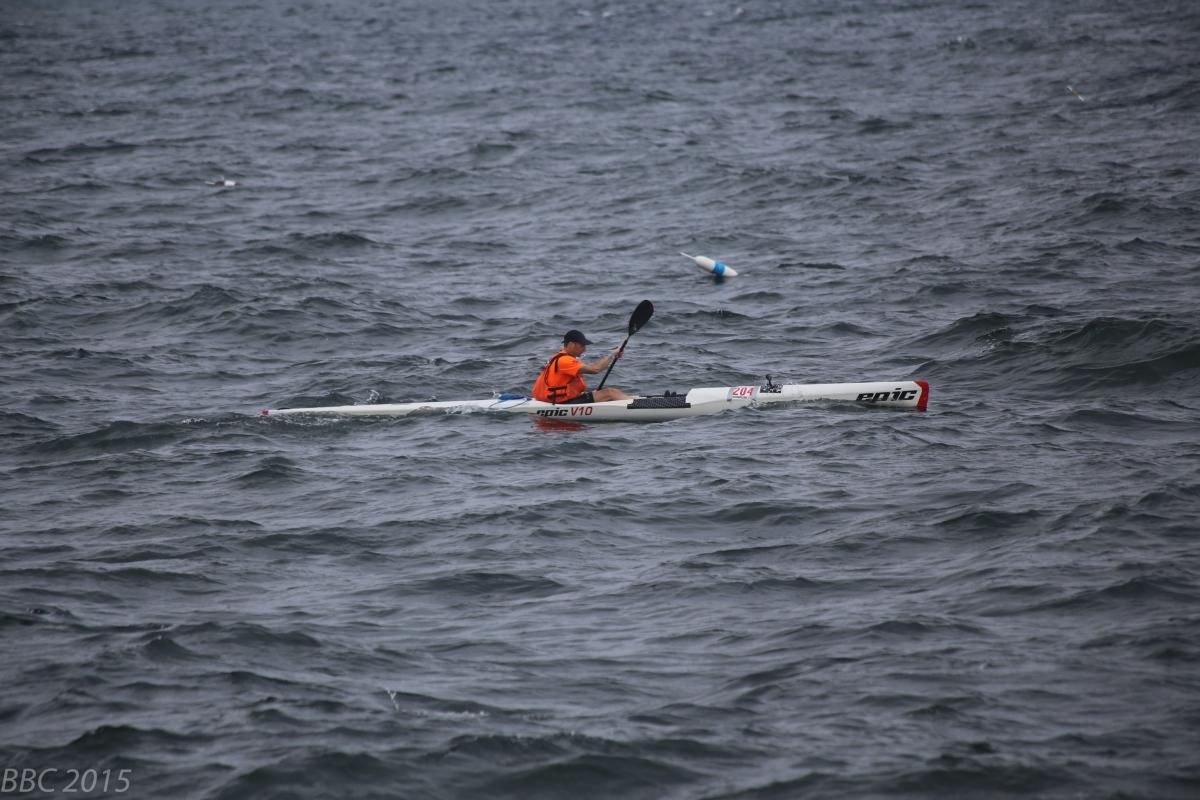
A few moments later, we rounded the Annisquam Harbor Light and finally got a gander at what awaited us. For the 3.5 mile stretch from here until Halibut Point, we'd be paddling directly into waves that probably averaged 3 feet, with the occasional 4 and 5 foot behemoths thrown in to keep us on our toes. I knew I'd need to lighten my load for the upwind struggle, so I jettisoned all technique and decorum. In this bare knuckles brawl, any effete consideration of proper form would just get me in trouble. Today would be all about outlasting the competition.
With Matt a length ahead, Craig angling north towards the arctic (did he learn nothing from the tragic Brennan scenario?), and Rob doggedly hanging just behind me despite his alleged flatwater specialization, I was feeling pretty good about my position. Surely the other Contenders weren't far behind, but I wouldn't give them the satisfaction of throwing a glance over my shoulder to check. Also,
For the last few weeks, I had been serving as sparring partner (or perhaps punching bag) for Matt in the Tuesday night Salem League to get him in shape for the longer races. He had been consistently beating me, but today he was in a lighter boat with a vestigial rudder. A mile into the rough stuff, he went over. Knowing that he has a spring-loaded remount, I didn't even bother slowing to check if he was OK. That'd be akin to askin' Billy the Kid if he needed any extra bullets while he was reloading. With Craig fending off tusked pinnipeds somewhere over the horizon, I staked my claim to second place.
The remaining trip to Halibut Point wasn't too technically challenging, but it required constant vigilance. The larger waves were curling at the top in a menacing manner, and more than a few times the front half of my boat liberated itself from the surface. The subsequent crash and palpable flex of the hull made me wonder exactly how long it would be before Mary Beth noticed I was no longer mowing the lawn. At some point I spotted Brian in his old-school West Side Boat on an inside line, perhaps a half-dozen lengths back. At least he'd be able to tell people that I perished like I lived life - begging for mercy from an indifferent God.
Apparently there had been some kind of nuclear incident at Halibut Point, because many of the boats ahead were rounding the promontory at a minimum-safe-distance comparable to that of Chernobyl. The formerly well-behaved waves were getting increasingly rowdy near the shore, granted, but I doubted that they would render anyone sterile. Just to be safe, I took a moderate line and leaned away from the point to put that extra layer of kevlar-carbon weave between my payload and the danger source.
The voyage from Halibut Point to Straitsmouth was particular onerous. The waves were now quartering from the port stern, constantly threatening to yaw my boat starboard into Sandy Bay. I saw Tom Kerr and Doug McCarthy in the water, but quickly averted my eyes when it became clear that Tom was having an intimate moment with their tandem ski. We'd all been out to sea for quite a while by this point, so I tried not to judge.
Although I hadn't noticed his stealth boat creep by, at Straitsmouth I saw Brian several lengths ahead of me. Just far enough, I told myself with barely disguised satisfaction, that it would hardly make any sense to attempt to catch him. Yet, you mean. Hmmm? Oh, right, yet. And that's how any slim chance at second place faded away. In Straitsmouth I shouted my number to the moored safety boat which, oddly, appeared to be staffed entirely by confused fishermen. Having cleared the strait, a temporary respite from the rough waters awaited.
On my deathbed (which I pray will be made from that memory foam - nobody wants to be forgotten), I'll look back at the next moment with bitter regret. An hour and a half into the race, I hadn't taken any liquid or solid sustenance. Heck, I had been holding my breath most of the time. Bracing on a skimming paddle blade while I still had some forward momentum, I fished around clumsily in my PFD pocket for an energy gel. Would throwing my legs out of the boat for added stability really have cost me that much? As I continued futzing around in my PFD, my boat came to a stop. Like a Warner Brother's cartoon character, I looked over at my sinking brace, then stared directly into the camera and mouthed "Mother?".
I went down hard on my weak side. I blew the remount. Then another. A third? Why not? After a prolonged struggle, I managed to get upright enough on my fourth attempt to tumble off on my strong side. Now we were talking! After corralling a spare water bladder that was sneaking off disguised as a Portuguese man-of-war, I finally made it back into the bucket. Given that I had been in the water for nearly 45 minutes, it seemed miraculous that nobody had caught me (save Rob Flanagan and Chris Kielb in their double, charmingly merry). I eased back into the race.
A mile beyond Straitsmouth, at Emerson Point, the waves finally began to jack up and align with my boat. Unfortunately, Jack up and aligned with my boat as well. Van Dorp had caught me unawares. If I had known he was closing in, I might have welcomed him with fewer curse words. Jack and I traded a few jabs on successive downwind runs, each looking for an opening that might provide some advantage. I fell off a playground slide onto my head as a kid, so I was hoping he wouldn't home in on that particular soft spot (like my mom did with that damned wooden spoon). Then, hooking into a nice ripper, I unexpectedly landed what appeared to be a knock-out blow. Having dropped Jack, I rejoiced in my superior downwind skills.
The video record shows that the coup de grâce I was so proud of was more of a phantom punch. Jack wallowed on a big wave and then, having lost most of his speed, crumpled to his left. He had trouble remounting in the steep waves, allowing me to pull away unmolested. Craig would soon be dismounted in this treacherous area as well, and similarly have difficulty clambering back in the bucket. Since Matt's contract stipulated that he capsize at least once a mile, it's a safe bet that he was dunked here too. I doubt he was in the water long enough to notice, though. Hugh definitely did not go in here, but given that he could barely reach his badly mis-calibrated rudder pedals, I doubt he had much fun. The cards were falling into place for me. Or, at least, out of place for everyone else.
After clearing Emerson Point, the seas flattened out a bit. There were still waves, but had to work much harder to track down good runners. Given the increasingly rubber-like quality of my arms, I can't say I was too effective in my hunt. In a typical Blackburn, the four mile long stretch of open water along the Back Shore is an upwind grind. Doubtless feeling a little guilty about that, this year the wind had given us a break. I was grateful, sure, but couldn't help but notice that the moderate, uneven rides offered up in this section were pale reflections of the massive and well-formed waves that we had plowed through to get to Halibut Point. Stupid wind. Can't do anything right.
I went over again trying to stay in a relationship with a wave that had commitment issues. When paddling in rough conditions like Saturday's, I can't stress enough how important it is to double-check that your paddle leash is securely fastened on at least one end. I didn't, and now I'm out a $10 leash. That crafty water bladder managed to slip away too. After taking big gulp of seawater to fortify myself, I remounted without problems and went in search of a new swell.
With downwind help, I arrived so unexpectedly early at Eastern Point Lighthouse that they hadn't had time to set up the traditional welcome buffet. Where were the boat wakes? The rogue breaking waves? The piping hot clapotis? The legendary smorgasbord of demanding conditions 16 miles into the race is a Blackburn institution, for pity's sake! Words could not express how incensed I was by the pancake-like flatness of the ocean by the Dog Bar, so I let a savage ear-to-ear grin do the talking.
Entering the harbor, I passed Rich Klajnscek (first rower), who informed me that no paddlers were in striking distance. Although this news should have taken some of the sting out of the slap-in-the-face upwind chop that now greeted me, it was too weak a salve. Even if I had third place virtually locked down (and Brian's indistinct form far ahead convinced me immediately that second wasn't in the cards), apparently they were still going to make me paddle the final couple miles. The joke was on them. By this point, you could hardly call my floppy-armed flailing "paddling". I'd finish on my terms.
The less remembered about that terrible trip across Gloucester Harbor, the better. I may have made some rash promises to get through that stretch (something about giving up beer?), but I don't think they'll hold up if I now claim a fatigue-induced blackout. It's a pretty great loophole. However it happened, I made it to the Greasy Pole. Brian was roughly a minute ahead of me. Sean, of course, had already published his memoirs ("We may never know if anyone finished behind me in that fateful Blackburn...") and retired to Florida.
In talking with Brian after the race, I discovered that as the last of The Contenders out of the Annisquam, he had lost track of most of the others in the big waves. Rounding the Dog Bar into Gloucester Harbor, he was astounded that they were all so far ahead of him he couldn't even spot them. Since situational awareness is such an important part of racing, I'm docking him a place and claiming silver.
I was pleased to see Matt pull in a few minutes later to take 4th place. Knocked down a dozen times over the last three hours, Matt would just bounce back into the bucket and carry on. Jack, Jan, and Craig finished together in a tight pack, with Robert, Hugh, and Joe Shaw (stepping in for a DNF'ed Ben) following in one minute intervals. Hawaii's 'Ale Hedlund took gold for the women, with Mary Beth claiming silver and bronze (because... moxie). Jim Hoffman and Steve DelGaudio, after demonstrating tandem remount techniques for the cameras at Halibut Point, easily took first in the doubles HPK division. Jay Appleton now holds the SS20+ crown. The Clara Barton award went to Bob Wright, who patiently nursed a series of collapsed racers back to upright positions.
As you can imagine, the after-party was particularly animated as racers tried to one-up each other with tales of terror on the high seas. There were numerous accounts of maritime rescues (by safety boats, the Coast Guard, and fellow racers), several detached amas (insufficient pre-race stretching, I'd wager), mammoth waves ranging in height from 7 feet to 10 meters (Canadians...), a half-dozen krakens (or at least near-krakens), and one possible EBW (missing paddler, incriminating flipper marks on boat). We can have an honest disagreement about whether this year's race was "exhilarating" or "terrifying", but it was indisputably the greatest Blackburn of all time. Or at least the one we're most likely to exaggerate about.
There was, of course, one heart-breaking aspect to this year's Blackburn. Even if you only knew Joe Glickman in passing, you felt his absence from the race he excelled in for so many years. The web is rightfully overflowing with tributes to the kindness and generosity of spirit that made Joe so beloved. I'll add one more anecdote. At the Double Beaver race in 2013, Joe spotted me from across the lawn of the Conanicut Yacht Club and walked purposefully over to where I was fiddling with my boat. He proceeded to compliment my recent post about that year's Blackburn, citing a few specific elements he found funny, and then to talk to me for a few moments as a fellow writer (despite the fact that I'm clearly not). I think often of that brief exchange, which left me feeling ten feet tall. A compliment, a kind remark, a mere interest from Joe made you feel that you were doing something right. And, given his magnanimous character, that meant he brightened the life of almost everyone he encountered.
I frequently used Joe as a foil in this blog - an effortlessly cool and hyper-competent guy in direct contrast to my blundering self. I obsessed (only half-facetiously) over besting him in something - paddling, CRASH-B's, anything, really - but, of course, never did. That's fitting. Glicker was, and always will be, one more mile ahead.
I'm assuming this won't come as a spoiler to many readers, but the meteorologists' mystic prophecies were fulfilled. Conditions were... I'm going to go with... lively. Last year was the fastest Blackburn ever, with 21 single skis breaking the 3 hour mark. This year, contending with 3 to 4 foot seas for the majority of the course, only 4 boats of any kind finished in under 3 hours. Four out of every five participants had to be resuscitated at least once during the race, property damages were in the high 7 digits (a bargain, Howie would argue), and the Man at the Wheel statue in Gloucester was reported to be weeping salty tears for the lost.
Of the 212 boats that started, 59 pulled out before the finish. Entire boat classes were DNF'ed out of existence. Eight sliding seat two-person rowing shells started, but only one made it around. Four boats literally fell apart in the rough waters. One of the shipwrecked rowers was proudly carrying the foredeck of his boat around the after-party, to the awe and amusement of the other attendees. It was a good day to be in a kayak - the 13 fastest solo times came from the HPK class - but most of those that started in a ski also spent some time out of a ski (including the 3rd through 7th finishers, who you'd think would know better).
At the registration tables at Gloucester High School, I was pleasantly surprised to find that the liability waiver now included a box for penciling in a short obituary. Smart. Figuring that the sheer volume of published notices would prevent any rigorous fact-checking, I elevated my rank to Commodore Lesher and credited myself with inventing cheese. My legacy secured, I joined in the prayer of deliverance that opened the captain's meeting. In truth (don't get used to it), there was an inappropriate lack of anxiety among those mustered in the cafeteria. One might even say there was a raucous comrade-in-arms levity.
 |
| One-third of HPK starters didn't finish. Look to your left. Look to your right. Both those guys are convinced you're going to be the DNF. And that your ears are kind of weird. (Photo courtesy of SurfskiRacing.com) |
Sean Brennan came out victorious in all but one of our simulated trials (eaten by walrus, oddly enough). The next few places, however, were a confused jumble of paddlers. We figured at least nine paddlers had a legitimate shot at silver: Jan Lupinski (hungry after a meandering performance in Casco Bay), Jack Van Dorp (Canadian, but with colorful shorts), Craig Impens (master of the intimidating Facebook post), Hugh Pritchard (who, in a charming old-world manner, apparently believes there's a pre-race dress code), Robert Lang (of the Kicked-My-Butt-in-Maine Langs), Ben Pigott (real trouble in flat conditions, a wildcard otherwise), and Brian Heath (with 11 top-five Blackburn finishes, just behind Gretzky and Trebek as the most storied Canadian of them all). That's only seven people, so Matt (too fast for his tender years) and I (nominative first-person singular pronoun) were forced to include ourselves in the list as well. I dubbed this group the Contenders. As to what that makes everyone else... I suggest Journeyman (an older paddler), Tenderfoot (a hypothetical youngster), or Bum (someone that coulda been a Contender, but chose a different path). We would also accept Palooka.
As we lined up for the start, we were told in ominous tones (I believe the announcer was holding a flashlight under her chin) that once we cleared the Annisquam, we'd be facing four foot seas. Although I noticed a few people blanch and heard one guy muttering to himself "You can do this, Lesher!", nobody turned in their number and headed back to the launch. With little fuss and no apparent moral compunction (probably has a good lawyer), the starter sent us off.
In the days before the race, I had pored over satellite photos of the Annisquam in search of some navigational advantage. Speed-draining shallows in the tidal river can mean that the straight-line route isn't necessarily the fastest path. I identified some candidate long-cuts, dusted off my compass and protractor set, and got to work plotting my victory. Was it worth the inscribed scratches and permanent marker on my monitor? We'd soon find out.
 |
| Despite the persistent rumors, the use of high-speed photography allows us to state definitively that Sean only has a single pair of arms. (Photo courtesy of Leslie Chappell) |
To my bewilderment, this course deviation actually provided some benefit. When I rejoined the mainstream paddlers, I found myself drafting Craig, who in turn was on Matt's wash. Sean had split from the Contenders some time ago. He was always more of a solo act anyways. Jan was a half-dozen boat lengths ahead of Matt. Robert was still just behind me, but I didn't know how far back Brian, Jack, Hugh, and Ben were. Given this information, logically deduce Jan's hat size.
After a few minutes of this, Craig veered left to cut the corner over a sandbar. Consistency has never been a strong point for me, so I followed him rather than keeping to the channel with Matt. The gamble paid off. As we left the Annisquam, the three of us were abreast. Might this race shape up to be a cerebral chess match like the Casco Bay Challenge a few weeks ago? That question is laughable in retrospect, but at the time it seemed like just the kind of pretentious twaddle I might write.
Ahead, in calm water and without warning, Jan went over. Someone gleefully yelled "Jan's down! Jan's down!" from my bucket. According to the swimmer (perhaps delirious from shock), the capsize was caused when an older female rower in front of him of suddenly stopped, then proceeded to catch an oar on his rudder. Sounds vaguely plausible, I suppose. Afterwards, Jan was telling people that my mother-in-law had sabotaged him. That's ludicrous. First of all, everyone knows I'm out to get the guy. I'm not going to be so carelessly blatant about it as to have my mother-in-law flip him. Do I look like an amateur? Second of all, it was actually my aunt. Regardless of who did or didn't toss Jan into the sea, he was out of second place. Matt, Craig, and I carried on. With this early fall in the most important New England race, Lupinski lost his confidence and, for the remainder of the season, couldn't get back in his groove. More prophetic words, I hope, were never written.
A few moments later, we rounded the Annisquam Harbor Light and finally got a gander at what awaited us. For the 3.5 mile stretch from here until Halibut Point, we'd be paddling directly into waves that probably averaged 3 feet, with the occasional 4 and 5 foot behemoths thrown in to keep us on our toes. I knew I'd need to lighten my load for the upwind struggle, so I jettisoned all technique and decorum. In this bare knuckles brawl, any effete consideration of proper form would just get me in trouble. Today would be all about outlasting the competition.
 |
| Like they say, the camera adds 10 pounds, a hump, and a beak-like nose. (Photo courtesy of Leslie Chappell) |
For the last few weeks, I had been serving as sparring partner (or perhaps punching bag) for Matt in the Tuesday night Salem League to get him in shape for the longer races. He had been consistently beating me, but today he was in a lighter boat with a vestigial rudder. A mile into the rough stuff, he went over. Knowing that he has a spring-loaded remount, I didn't even bother slowing to check if he was OK. That'd be akin to askin' Billy the Kid if he needed any extra bullets while he was reloading. With Craig fending off tusked pinnipeds somewhere over the horizon, I staked my claim to second place.
The remaining trip to Halibut Point wasn't too technically challenging, but it required constant vigilance. The larger waves were curling at the top in a menacing manner, and more than a few times the front half of my boat liberated itself from the surface. The subsequent crash and palpable flex of the hull made me wonder exactly how long it would be before Mary Beth noticed I was no longer mowing the lawn. At some point I spotted Brian in his old-school West Side Boat on an inside line, perhaps a half-dozen lengths back. At least he'd be able to tell people that I perished like I lived life - begging for mercy from an indifferent God.
Apparently there had been some kind of nuclear incident at Halibut Point, because many of the boats ahead were rounding the promontory at a minimum-safe-distance comparable to that of Chernobyl. The formerly well-behaved waves were getting increasingly rowdy near the shore, granted, but I doubted that they would render anyone sterile. Just to be safe, I took a moderate line and leaned away from the point to put that extra layer of kevlar-carbon weave between my payload and the danger source.
 |
| By the end of the race, Jack and his boat could fit comfortably in the palm of your hand. (Photo courtesy of Leslie Chappell) |
Although I hadn't noticed his stealth boat creep by, at Straitsmouth I saw Brian several lengths ahead of me. Just far enough, I told myself with barely disguised satisfaction, that it would hardly make any sense to attempt to catch him. Yet, you mean. Hmmm? Oh, right, yet. And that's how any slim chance at second place faded away. In Straitsmouth I shouted my number to the moored safety boat which, oddly, appeared to be staffed entirely by confused fishermen. Having cleared the strait, a temporary respite from the rough waters awaited.
On my deathbed (which I pray will be made from that memory foam - nobody wants to be forgotten), I'll look back at the next moment with bitter regret. An hour and a half into the race, I hadn't taken any liquid or solid sustenance. Heck, I had been holding my breath most of the time. Bracing on a skimming paddle blade while I still had some forward momentum, I fished around clumsily in my PFD pocket for an energy gel. Would throwing my legs out of the boat for added stability really have cost me that much? As I continued futzing around in my PFD, my boat came to a stop. Like a Warner Brother's cartoon character, I looked over at my sinking brace, then stared directly into the camera and mouthed "Mother?".
I went down hard on my weak side. I blew the remount. Then another. A third? Why not? After a prolonged struggle, I managed to get upright enough on my fourth attempt to tumble off on my strong side. Now we were talking! After corralling a spare water bladder that was sneaking off disguised as a Portuguese man-of-war, I finally made it back into the bucket. Given that I had been in the water for nearly 45 minutes, it seemed miraculous that nobody had caught me (save Rob Flanagan and Chris Kielb in their double, charmingly merry). I eased back into the race.
 |
| A rare moment of competence in a sea of "Whoa..." |
The video record shows that the coup de grâce I was so proud of was more of a phantom punch. Jack wallowed on a big wave and then, having lost most of his speed, crumpled to his left. He had trouble remounting in the steep waves, allowing me to pull away unmolested. Craig would soon be dismounted in this treacherous area as well, and similarly have difficulty clambering back in the bucket. Since Matt's contract stipulated that he capsize at least once a mile, it's a safe bet that he was dunked here too. I doubt he was in the water long enough to notice, though. Hugh definitely did not go in here, but given that he could barely reach his badly mis-calibrated rudder pedals, I doubt he had much fun. The cards were falling into place for me. Or, at least, out of place for everyone else.
I went over again trying to stay in a relationship with a wave that had commitment issues. When paddling in rough conditions like Saturday's, I can't stress enough how important it is to double-check that your paddle leash is securely fastened on at least one end. I didn't, and now I'm out a $10 leash. That crafty water bladder managed to slip away too. After taking big gulp of seawater to fortify myself, I remounted without problems and went in search of a new swell.
With downwind help, I arrived so unexpectedly early at Eastern Point Lighthouse that they hadn't had time to set up the traditional welcome buffet. Where were the boat wakes? The rogue breaking waves? The piping hot clapotis? The legendary smorgasbord of demanding conditions 16 miles into the race is a Blackburn institution, for pity's sake! Words could not express how incensed I was by the pancake-like flatness of the ocean by the Dog Bar, so I let a savage ear-to-ear grin do the talking.
Entering the harbor, I passed Rich Klajnscek (first rower), who informed me that no paddlers were in striking distance. Although this news should have taken some of the sting out of the slap-in-the-face upwind chop that now greeted me, it was too weak a salve. Even if I had third place virtually locked down (and Brian's indistinct form far ahead convinced me immediately that second wasn't in the cards), apparently they were still going to make me paddle the final couple miles. The joke was on them. By this point, you could hardly call my floppy-armed flailing "paddling". I'd finish on my terms.
The less remembered about that terrible trip across Gloucester Harbor, the better. I may have made some rash promises to get through that stretch (something about giving up beer?), but I don't think they'll hold up if I now claim a fatigue-induced blackout. It's a pretty great loophole. However it happened, I made it to the Greasy Pole. Brian was roughly a minute ahead of me. Sean, of course, had already published his memoirs ("We may never know if anyone finished behind me in that fateful Blackburn...") and retired to Florida.
 |
| With an impressive 4th place finish, Matt celebrates his ascendance from "up-and-coming" to "target". (Photo courtesy of Leslie Chappell) |
I was pleased to see Matt pull in a few minutes later to take 4th place. Knocked down a dozen times over the last three hours, Matt would just bounce back into the bucket and carry on. Jack, Jan, and Craig finished together in a tight pack, with Robert, Hugh, and Joe Shaw (stepping in for a DNF'ed Ben) following in one minute intervals. Hawaii's 'Ale Hedlund took gold for the women, with Mary Beth claiming silver and bronze (because... moxie). Jim Hoffman and Steve DelGaudio, after demonstrating tandem remount techniques for the cameras at Halibut Point, easily took first in the doubles HPK division. Jay Appleton now holds the SS20+ crown. The Clara Barton award went to Bob Wright, who patiently nursed a series of collapsed racers back to upright positions.
 |
| Once you win silver, you don't want to contaminate yourself by actually touching bronze. |
There was, of course, one heart-breaking aspect to this year's Blackburn. Even if you only knew Joe Glickman in passing, you felt his absence from the race he excelled in for so many years. The web is rightfully overflowing with tributes to the kindness and generosity of spirit that made Joe so beloved. I'll add one more anecdote. At the Double Beaver race in 2013, Joe spotted me from across the lawn of the Conanicut Yacht Club and walked purposefully over to where I was fiddling with my boat. He proceeded to compliment my recent post about that year's Blackburn, citing a few specific elements he found funny, and then to talk to me for a few moments as a fellow writer (despite the fact that I'm clearly not). I think often of that brief exchange, which left me feeling ten feet tall. A compliment, a kind remark, a mere interest from Joe made you feel that you were doing something right. And, given his magnanimous character, that meant he brightened the life of almost everyone he encountered.
I frequently used Joe as a foil in this blog - an effortlessly cool and hyper-competent guy in direct contrast to my blundering self. I obsessed (only half-facetiously) over besting him in something - paddling, CRASH-B's, anything, really - but, of course, never did. That's fitting. Glicker was, and always will be, one more mile ahead.


