Friday, April 16, 2021

Narrow River Race: Redux

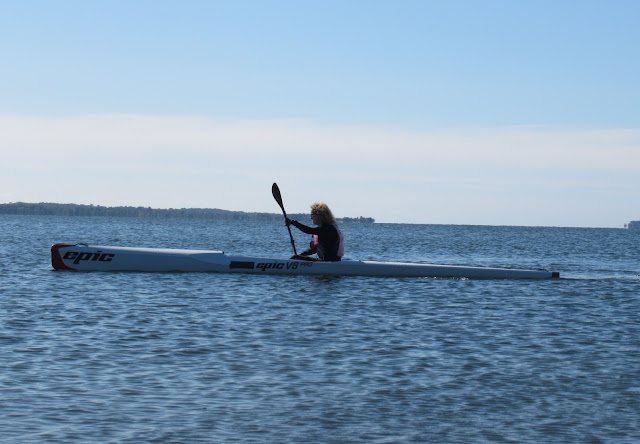
After months of intensive lobbying of race director Tim Dwyer, I managed to have last year's Narrow River Race expunged from the records.  Delayed from April to October by COVID and subsequently capped at only 10 paddlers, one can hardly tolerate such an illegitimate farce disgracing the official annals.  I felt bad that Mike Florio's first-ever surfski victory would be coincidentally voided, but the common good must prevail.  He'd probably want his inaugural gold medal to be by more decisive a margin than a mere five and a half minutes anyway.

With less stringent gathering restrictions, it looked like the 2021 run of the Narrow River Race would be fully sanctioned.  Pending suitable results, of course.  Nearly the entire field of last year's pseudo-race responded to their summons for a rematch, to be joined by a dozen other paddlers, including the first ever C-2 entry.  Even though he was quick to play the "I haven't been training much" card (adding it to the growing pile), all eyes were on Mike.  Having worked out recently with Chris Chappell, I knew he'd be a serious threat as well.  Vibrantly named newcomers Loukia Lili, Josco Catipovic, and, er, Jeff Tucker chose the Narrow River for their first surfski race.  Loukia, a national-caliber amateur triathlete, celebrated her 40th birthday by driving 5 hours on a whim to compete with us.  That kind of vigor and enthusiasm might be inspiring to some, but sent several of the more world-weary competitors to pre-race naps in their cars.

Carole graciously offered to provide sign language interpretation, but Tim's gesticulations left no room for confusion.

After years of yoga and meditation, Wesley finally achieved inner bliss just moments before the race.  Unfortunately, he lost it 3 minutes after the start.

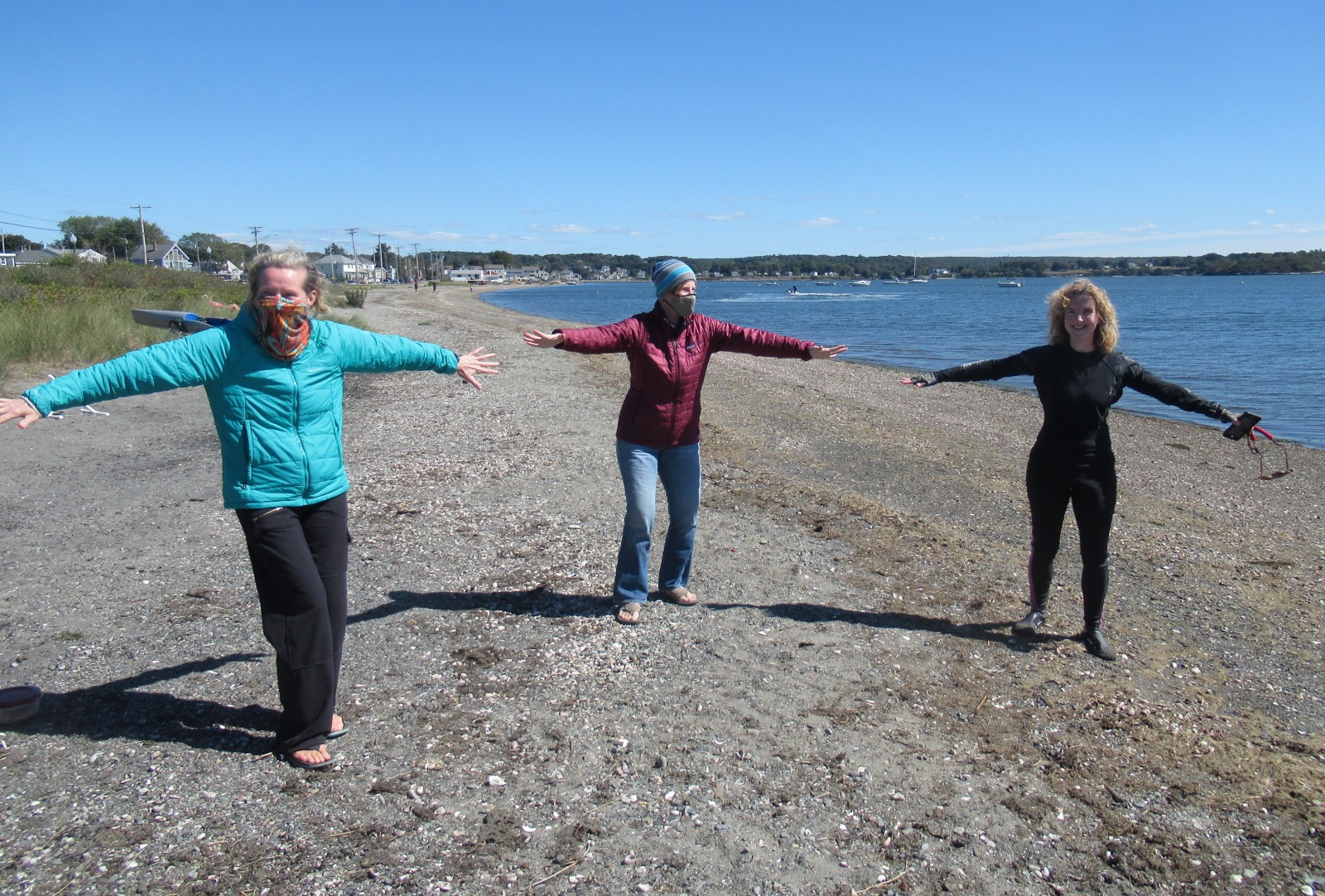
With the post time rapidly approaching, Tim called on us to "huddle up" for the captains meeting.  He made beckoning gestures with his open arms, but the rest of us collectively decided to maintain a reasonable social distance.  Because of the pandemic, we told him.

We'd be running the standard 8 mile course.  After heading upriver for 3 miles, we'd turn at a rowing club dock, reverse our way back past the launch, turn on some pilings a mile downriver, then finish back at the start.  With temperatures in the 50s and only a light breeze, conditions were perfect.  From the shore, it was difficult to tell whether the notoriously depth-challenged river contained enough liquid for safe passage.  For a change, I couldn't see any writhing fish struggling to keep their gills immersed, so perhaps we'd be OK.

I felt kinda bad for hazing Loukia by telling her that newbies were expected to perform an interpretative dance at the captains meeting, but she really knocked it out of the park.

We hit the water.  A nucleus of fast-twitch paddlers formed on the left side of the line, to be quickly surrounded by a buzzing shell of hangers-on attracted by the prospect of getting pulled along for the ride.  I chose a neutral path to the far right - too proud to wring ill-gotten gains from the sweat of my competitors.  That's how I'm couching my tactical positioning blunder, at least.  In the soothing tones of a time-and-temperature operator, Tim counted us down to an incongruously low-key start.  After a moment of disorientation, I shook the sleep from my eyes and launched immediately into a recurring nightmare.  You know the one: Everyone else is off to a great start, you can't remember how a paddle works, and you're pants-less.  In a horrific new twist, however, the velcro on one of my pogies had also come loose, leaving it free to slide up and down my paddle with every twitchy stroke.

As expected, Mike and Chris C led the charge on the left, flanked by John Costello in a boat several notches less streamlined.  Mark Wendolowski, Chris Quinn, Tim D, and Tim Hacket followed closely behind.  My vantage point from open water to the distant right provided a welcome detachment from the crushing sense of inadequacy I usually feel when falling behind early.  It was almost as if I was floating in my boat, watching the race from far away.  Lest I were to drift even further into reverie, I forced myself to focus (with a little help from those old friends, lactic acid and panic) and join the fray.  I angled alongside Tim D, and, after exchanging some pleasantries with our host, started to work slowly up the rankings.  I moved past Chris Q (uncharacteristically shirted) and Mark (not generally a saltwater paddler, but adapting well to the brackish conditions).  By this point, Mike was out to an 8 length lead over Chris C, with John now struggling to stay on Chris' draft.

While closing the 3 length gap to John over the next couple of minutes, I marveled at his power and efficiency.  Despite taking a single stroke for every 14 of mine (give or take), he was pushing a V10 Sport at practically the same speed as my V14.  I'm just hoping that restraining order against his beam remains in place at 19".  I tried to slip by John as quietly as possible, much as you'd tip-toe past a hibernating bear.  I made it by, but wouldn't really feel comfortable with him behind me until I had put a sacrificial offering between us.

After one too many close shaves with duck hunters, Chris now errs on the side of caution.  (Photo courtesy of Bob Wright)

It took me several minutes to catch Chris.  Since he had shown me such generous hospitality in the past, I figured on settling in the unused plot immediately behind him.  I'd squat there temporarily - at least until my application for permanent residency was approved.  Maybe I'd pop alongside Chris every now and again to borrow a cup of sugar, but mostly I'd just keep quarantined in my cozy new home.  You can imagine my surprise, then, when my hunkering was interrupted by sharp pangs of conscience.  My shame threshold is pretty high, so for feelings of guilt to reach the surface requires some truly disgraceful behavior.  Apparently, I'd be expected to show some integrity.  Frankly, the better angels of our nature can be a real drag.  Reluctantly, I abandoned my newfound shelter and tried to pass Chris.

We paddled side-by-side for several minutes as the Narrow River widened into a slightly less narrow lake.  Our race-within-a-race was soon embedded within yet another race, as we found ourselves unwitting participants in a pairs sculling contest.  Given that the other racers had cleverly devised a method of applying power simultaneously on both sides via a mind-boggling lever-and-fulcrum mechanism and managed to shoehorn 2 people in each boat, I didn't like our odds.  Chris and I leveled the field a little bit by charging down-course well before the starting gun, but within seconds the sculls had erased our handicap.  Fortunately, we were gently nudged to one side by the race director's bullhorn before the rowers were able to dismount us.  Twenty-five lengths ahead, Mike showed himself impervious to those same amplified commands, but his line to our turn-around naturally diverged from their course well before any blows could be exchanged.

During the interdisciplinary excitement, I managed to start pulling away from Chris.  I reached the turning point several lengths ahead, buoyed by the (quite possibly sarcastic) cheers from the crew club supporters lining the docks to applaud their racers.  Heading back down the lake, I saw John perhaps 15 lengths behind Chris, with Mark and Chris Q back again as far.  Now working against a light wind and mild current, my speed dropped a little, but not to the extent I had feared.  Based on a few quick glimpses of Chris back over my shoulder, I seemed to be prying open the gap.

I mentioned that I had suffered a catastrophic pogie failure back at the start.  For the last 30 minutes the partially attached pogie had been flapping against my left hand, but I couldn't afford to stop and remedy the situation.  It was becoming clear, however, that the situation had ripened from an annoying distraction to a life-threatening predicament.  Because of a genetic abnormality (self-diagnosed, but nonetheless completely not made-up), my skin lacks the polyproline IIIa collagen necessary to fend off minor abrasions and irritations.  I'm a very sensitive fellow.  In the absence of any more estimable character traits, my cruel high school classmates voted me Most Likely to Chafe.  Over the years I've been referred to a succession of specialists, all of whom strongly advised that I avoid any leisure activity that involved repetitive motions while clad in neoprene.  That kind of thing wasn't really my groove anyway, so I got into paddling.  Despite applying ample space-age lubricant, I've grown accustomed to the angry abrasions that circle my waist during the paddling season.  I'm happy to endure second-degree chafing over 30% of my body to secure a podium finish, but I was pretty sure that I could now see bone where the flopping pogie had rubbed the skin off my thumb.

Off the course... nicest guy you could meet.  On the course... diabolical supervillain.  Cool costume, though. (Photo courtesy of Bob Wright)

Having put some distance on Chris, I decided to risk a quick stop to salvage enough dermis to accept a graft (donations welcome).  I figured that removing the pogie entirely would be quicker than reattaching the loose side, but I hadn't anticipated that the remaining velcro would have the cohesive strength of welded steel.  Twenty-some minutes later, I managed to detach the cursed thing and fling it disgustedly in my footwell.  My lead on Chris had been reduced to a dozen lengths, but at least I'd managed to save my fourth most cherished extremity (list available upon request).

Progress downriver continued at a reasonable pace until I approached the launch area, where the river straightens and widens into a marshy stretch.  This revealed the extent to which the winding river had been protecting us from the growing southerly breeze.  More critically, however, with an expansive floodplain to enjoy, the water abandoned the constrictions of a navigable channel and kicked back in the shallows.  Knowing the suck water was coming, I braced for the sudden deceleration, making sure both knees were slightly bent to better absorb the impact.  Physically, I suffered only a mild case of whiplash and a couple of lost fillings.  But how does one measure the toll on the spirit?

I had suddenly lost about 15% of my former speed.  My energy and morale reserves were bottoming out (which was also a constant threat to my ski), but I eventually made it to the downstream turn.  Nearby, a couple of fisherman were standing in holes they had dug in the riverbed to try out their waders.  One needlessly apologized for casting in my general vicinity.  Given that he wouldn't be able to unsee the horror of my cross-current turn, I assured him that he was more sinned against than sinning.

Even after we explained the paradox to him, Bob insisted on trying to get a shot of himself finishing.

Clad completely in unbreathable fabric, Dave had limited options for shedding excess heat.

For the final mile back to the finish, I waited in vain for some help from what was now a stiffening tailwind.  The relentless pull from the shallows was trumping any assistance from wind or current.  Not until the final quarter mile was I able to loosen the shackles enough to exceed "brisk walk" pace. Although it was impossible to measure exactly how much earlier Mike had finished due to his warping of the space-time continuum, my best guess is that he was 5 minutes or so ahead - just off the course record he had set back in the fall.  Gold at last for Mike!  Chris C finished roughly a minute behind me, with John, Chris Q, Mark, and Tim following over the next few minutes.  First-timer Loukia broke her winless streak as the first female finisher, with Mary Beth taking second.

Since our normal post-race venue wasn't open for outdoor dining, we contented ourselves with hobnobbing in the parking lot.  At least until the vice squad showed up to break up the depravity.  Thanks to Tim for hosting another fine day on the water.

In a normal year, the Run of the Charles and the Essex River Race would be next on our agendas.  Due to COVID, however, the former is being run as a virtual race, while the latter has been shifted to early October.  The vacuum left by these changes has sucked Tim's Battle of the Bay from mid-summer to mid-spring.  The race will be held on May 15 at its new (as of 2020) Goat Island home.  Register at PaddleGuru.

Monday, November 9, 2020

Narrow River Race: New Order

The Narrow River Race typically serves as a gentle introduction to the New England racing season - a controlled opportunity for us to get our feet wet.  Indeed, the winding tidal estuary is so shallow that it'd be impossible to get any other part of your body wet without lying down and rolling in it.  But as if in fulfillment of some arcane prophecy ("That which was first shall be last..."), this year's race was mystically displaced from early April to Halloween.  I suspect that co-directors Tim and Wesley are responsible, but for liability reasons, they deny all involvement.

On the eve of the race, Rhode Island's governor slashed the state's outdoor gathering threshold from 15 to 10 - mostly in response to complaints about rowdy surfski gangs ("fetid hooligans" in the press release) terrorizing local boaters.  Wesley scrambled to cull the field, deftly finding volunteers willing to sit this one out in lieu of "future considerations".  The more canny ex-participants, realizing they had some leverage, managed to extract more concrete guarantees.  So we can expect (for example) to see Dave Thomas pipping Tim at the line to take bronze in next year's Ride the Bull.  Congrats on that podium finish, Dave!

Running on a tight schedule, Wesley came directly from his town crier gig.

As an aging competitor, I must rely more upon wits than vigor to have any hope of restoring the vibrant hues of my faded glory.  Quibblers will point out that - at best - I peaked at mauve.  Even so, to certain species of bees I was dazzling to behold!  In any event, a key strength these days is a network of informants who keep me apprised of the latest paddling scuttlebutt.  Since late spring, alarming reports about Mike Florio's training had been flowing in from my snitches, filled with adjectives like "hell-bent", "maniacal", and "chiseled".  Results from virtual races during the summer revealed that his work ethic was paying handsome dividends.  Although we've had quite a few close races, I've always managed to finish ahead of Mike.  Like any self-respecting coward, I naturally prayed that I'd be able to avoid in-person confrontations this season.  Mike could beat me from here to next Thursday in theory, but nobody will remember hypotheticals when they're poring through results 100 years from now. 

With all the shoulder season flatwater races cancelled, it looked like I might slip through the year without losing to Mike - open water isn't exactly his kryptonite, but when he wants to temporarily feel like a human, that's where he heads.  The announcement that the Narrow River Race would be rescheduled for October therefore came as quite a blow.  Fortunately, it came early enough for me to ramp up my training.  Each day I would stretch Mike's imagined victory gap a littler further, thereby gradually extending my tolerance for obsolescence.  With any luck, this enhanced flexibility would prevent my ego from snapping on race day.

As Tim reviews the race rules, non-partisan observer Sam monitors for inconsistencies, misconduct, and improprieties.  Look for his multi-volume report soon.

The 8 mile course was familiar.  We'd head up the Narrow River for 3 miles, reverse back down a mile past the launch, then turn and finish back at the start.  The downstream turn would be around a buoy, but the upstream turn would be at a rowing club dock.  With a particularly high tide, most of the course would remain moist enough to qualify as liquid.  Although we had received 6 inches of snow the previous day at home north of Boston, we'd be racing under sunny Rhode Island skies with temperatures in the 40s.

After a cursory captain's meeting ("Everyone cool?  Cool."), we hit the water and warmed up.  My only real chance at beating Mike was to latch onto his wash and hope he snapped a rudder cable just before the finish.  I hoped to use Chris Chappell's typical explosive start to launch myself into Mike's orbit.  I'd hitch a ride with Chris until this first stage ran out of propellant, then switch neatly over to Mike as he rocketed by.  Wesley counted our intimate group down to the start and we were off.  Before I managed to finish my first stroke, Chris had already thrown cold water on my ambitious drafting plans.  I had neglected to observe the clearly marked "Blast Zone" demarcations and thus found myself immersed in Chris' waste-water torrent.  Sputtering under this chilly dose of disdain, I watched helplessly as my booster pulled away without me.  On the far left of the line, Mike had also got out to a strong start.  I briefly jockeyed with Wesley and Jerry Madore before breaking free to pursue the leaders.

Mike enjoys a last moment of his innate pre-race humility, knowing he must soon adopt the haughty arrogance we expect from a dominant champion.  Don't let us down, Mike!

It looked like Chris might grab onto Mike as their paths converged, but years of lifeguarding had left the latter with a permanent sheen of glistening sunscreen - the guy is as slippery as a greased eel.  Chris lunged at his wash, but came up empty handed.  I needed to generate a revised action plan.  I can usually think quickly on my feet, but that seemed inadvisable in the V14.  The best I could come up with from the safety of the bucket was to catch Chris and then work together to reel in the rapidly receding upstart.  It took a half mile to accomplish the first part of the strategy, the effort of which made me abandon the second part as a foolish fantasy.  Mike had already left the stratosphere.  I settled in behind Chris as we wended our way upstream.  

Entering the lake-like section of the course where the Narrow River isn't, I finally pulled even with Chris and prepared to drop him.  We'd had a good thing - perhaps a bit one-sided, sure - but it was time to move on.  I planned on letting him down easy - you know, "It's not you, it's me." and "I need some time off to work on myself."  I didn't have the guts (or balance) to look him in the face while I delivered my spiel, but I said my piece and ramped up the effort.  Although he didn't reply vocally, Chris' actions categorically stated that no, we were going to remain joined at the gunnel until he decided otherwise.  Although he appeared to have reality bolstering his argument, let's just say we agreed to disagree about our continued relationship.

Last year I miscalculated my arcing approach, botching the turn so badly that a drafting Chris Q nearly went down in the Narrow River annals as its first-ever maritime disaster.  Quinn was too polite to remind me of my role in the near-catastrophe before the race, but at the starting line I couldn't help but notice the crude repair of the divot in his V12's bow - a silent rebuke to my incompetence.  Wary that a repeat performance - even with a different Chris - might lead to a post-race censure and/or beating, I made sure to adopt a different approach trajectory from this year's draft companion.  The result was that Chris and I spirographed radically different loops by the dock.  My radius setting was miscalibrated, however, which put me back several lengths once we were both pointing back downstream.  I saw Chris Q and Tim dueling it out heading towards the turn, perhaps two minutes behind us.

I had ample opportunities to hone my lurking skills.  (Photo courtesy of Jan Lupinski)

I caught back up to Chris about halfway down the lake, settling in on his side wash after an anemic attempt to muscle past him.  I'd spend the next 3 miles yo-yoing between side and rear drafts, spiced with a couple brief periods of panic falling off the back.  Readers with a delicate sense of justice (and smell) may be picking up the distinct scent of weasel emerging from the page.  Combining the upriver and downriver legs, I've admitted to spending at least 4 miles on Chris' draft, while claiming I pulled him for a mile.  But given an allegiance to the truth generously categorized as "casual", it's probably safe to assume that even these values were fudged to make me look less parasitic.  In my defense, I made a couple of disingenuous efforts to take a turn in the lead - in much the same way a post-dinner Thanksgiving guest might offer to help with the dishes while lowering himself into the recliner, unbuttoning his pants, and strapping on a sleep mask.  Perhaps sensing my need for a nap, Chris graciously declined my proposals.

As the end of race drew close, my conscience started to kick in.  Did I really want to be the bloodsucker who drafts off some unwitting host for the whole race and then darts ahead in the final 100 meters?  I plumbed the depths of my soul for an answer.  Fortunately, the oily waters therein were as shallow as the Narrow River, so I quickly found the response.  Wasn't even fully submerged.  Yes!  I definitely wanted to be that guy!   Lesher.  Leecher.  I was born for it!  There was only one problem.  I lack the fast-twitch power to execute such a gloriously underhanded plan.  Even fatigued from all the heavy lifting he'd been doing, Chris would swat away any last-second challenge I could muster.  I'd have to settle for the (marginally) less ethically dubious approach of making my move with a mile or so left.

The downriver turn seemed the ideal place to repay Chris' magnanimity with treachery.  I hadn't inspired confidence in my turning ability at the upriver turn, which perhaps lulled my competitor into a false sense of security approaching the buoy.  Chris went slightly too deep on the turn, allowing me to carve a path inside of him and seize the lead.  Lest you get some romantic NASCAR vision of this maneuver, what it really looked like was two blokes of advanced years, balanced precariously on 20 foot boats crosswise to the current, desperately flailing on one side to get their noses pointed upstream while keeping their bodies pointed above stream.  Since I emerged first from this exercise, I guess Tom Cruise will get to play me in the movie.

After our comical phase of blunders (groan through the pain), I held perhaps a three boat lead on Chris.  After being ferried along for so much of the race, you might imagine that I'd have a virtually untapped store of energy to propel me through the final mile.  But the truth is that even while drafting, I had been hurting.  In the final stretch, I tried to concentrate on form to compensate for waning strength and stamina, but I think most of my rotation came from craning around to see if Chris was gaining.  Despite a dreadful case of noodle arms, I seemed to be maintaining my lead.  Presumably Chris was suffering too, and with better justification.

I must have blacked out for a while, because my next memory is gnawing on a banana next to my car with Chris congratulating me - sarcastically, I imagine - for a race well run.  We agreed that without spurring one another on, Mike would have had an even more dominating performance.  As it was, he finished more than 5 and a half minutes ahead of us, covering the 7.98 miles of the course in 1:01:12.  That's an average of 7.82 mph - on a roundtrip course that includes shallow suck-water, fickle currents, and two 180 degree turns.  For perspective, that breaks Borys Markin's Narrow River record for pace.  We better keep an eye on this fledgling.  Or at least on the blur we suspect may be him.

For glory, honor, and - most importantly - that extra SSR series point.

Mary Beth and Igor Yeremeev gave us the best finish of the season.  Although Igor appeared to have their head-to-head race locked up with less than a mile to go, he unwisely chose the optional portage route, setting up a quarter-mile drag race to the line.  On the shore, I crouched to get a water-level view of the finish as other spectators cheered on the duo.  I'm proud to say that I didn't let my deep affection for Igor cloud my judgment - Mary Beth literally inched out the victory, taking the women's crown in the process.

Well, that's it for the 2020 season.  My deepest thanks to Wesley and Tim, without whom the last race of 2019 would have been it for the 2020 season.  With any luck, we'll see everyone for the second match of the Narrow River double-header in April.


Wednesday, September 23, 2020

Sakonnet Race: A Turn for the Worse


I've had enough.  I'm tired of constantly explaining that the Sakonnet River Race takes place in the ocean.  One year I had T-shirts printed up that said "The Sakonnet River Isn't", but this might have been too subtle - people kept spinning me around by my shoulders to read the rest on the back.  Taking a page from forward-thinking sportswriters (and now the organization itself) who took to referring to the NFL franchise as the "Washington Football Team", I'll henceforth be conscientiously omitting the offensive R-word nickname from references to the Sakonnet Race.  It strikes me that by creating a goofy analogy to a serious social issue, I might myself be guilty of gross insensitivity.  Better hold off on that new mascot I was going to propose for the race.

Since its 2008 inception, the Sakonnet Race has started at McCorrie Point.  Plagued by inconsiderate out-of-town visitors to that beach, locals successfully petitioned the municipality to limit parking to residents only starting this year.  Wesley was among the group wanting to limit access to his back yard launch - I'm guessing he was getting tired of the horde of fishermen taking bets on whether they could snag his boat as he paddled by.  By shutting down the beach to non-residents, however, he had successfully hoisted himself (and the race) with his own petard.  He's been experimenting with exotic new safety leash systems this season, so I can't say I'm that surprised at this mishap.  At least until he can get a waiver for the rule he himself had championed (wait... where have I heard that recently?), we'll be running an alternative course for the race.

For 2020, the start would be from Island Park Beach, located at the north end of the bay.  We'd proceed 4.6 miles out of the bay along its western shore, casting wistful glances at McCorrie Point roughly 3 miles into the trip (with the fishermen likely casting lead right back).  We'd then turn on a "No Wake" buoy near Sandy Point and head back to the start.  With a steady 15 mph wind from the north, the initial downwind leg would pass in a flash, while the return trip would, by my watch, still be underway now.  We'd actually covered the same water in two weather-adjusted previous Sakonnet races, but by starting at McCorrie rather than at an endpoint, the upwind slog was split into two more manageable segments separated by a long downwind leg.  This year there was no installment plan - the bill would have to be paid in one lump sum.

Responses to Wesley's captain's meeting ran the gamut from nausea to catatonia.
Dave chose to be in my photo rather than Gavin's, but clearly had some regrets about this decision.
At the end of August, some higher-up in the Meteorology Department had "accidentally" flipped his calendar directly to October to get to that adorable photo of otters having a tea party (to be fair, September's road-kill possum tableau was a real downer).  As a result, after strapping the boats on the car we had to swing by the emergency room so that I could have a couple of frost-bitten fingers amputated.  Don't worry - it wasn't the best ones.  The Doctor (if that was even his real name) expressed some doubt that 42 degrees was sufficient to do lasting tissue damage, but I told him to shut up and keep sawing.

By the time we reached Island Park Beach, the temperature had increased enough that I could finally move again, although most of that movement was confined to uncontrollable shivering.  Jim Hoffman asked if I wanted to borrow some warmer clothes, but he was unable to discern if I was shaking no or nodding yes.  When he graciously repeated the offer after the race, I got wise and blinked once for yes.  As we all know, Jim was inadvertently dropped into a vat of Human Growth Hormone as an infant, after which a well-meaning lab technician popped him into the gamma-wave chamber to dry him off.  That's why he has to buy all his clothes from Linebackers-R-Us and can melt titanium with his thoughts (oddly enough, only titanium - so unless you have an artificial hip, you're probably safe).  I was grateful for the loaner fleece, but had to keep the hood up over my head to prevent my shoulders from sliding through the neck hole.

With Rhode Island restricting outdoor gatherings to 15 people, we had a cozier than normal crew for the Sakonnet Race. In addition to a nice sampling of regulars from Greater New England, we had a delightful smattering of irregulars from regions beyond - John Costello (NJ), Melinda Schlehlein (NJ), and John Redos (PA).  Given that conditions would vary so much during the race, it was tough to handicap the field.  I had a particular respect for Tim Dwyer, though.  He's had a solid season, sure, but more importantly, he's consistently exhibited an almost pathological lack of concern for paddlers in distress - a critical component to success when you're in a race in which some poor sap is likely to be floundering beside my, er, his boat.  For months after the 2018 Gorge Downwind Champs, I'd awake screaming "Tim!  For Pity's sake, don't leave me, Tim!"
Color-coordinated.  Fashion-forward.  Bad-ass.
None of the above.
Once Wesley had gathered us around and sworn us in as deputies (I assume - I was fiddling with my hydration system during the meeting), we hit the water and lined up for the start.  I would have put my money on Chris Chappell to jump out to an early lead, but even at very generous odds, nobody is taking that bet anymore.  Tim and Wesley had fine starts in direct pursuit of Chris, with John moving swiftly from the right of the line.  I had a decent enough start to merit some back-handed compliments from the field as I pulled even with the leaders.  As I recall, something vaguely like "Tim, will you check me for weeds?  Because there's no other way Listless Lesher could have already caught me."  Now that I see it verbatim in writing, seems more like a fore-handed insult.  In any event, I showed those guys by inching forward at an almost imperceptible rate.

As we moved further from the lee of the shore, the conditions gradually transitioned from flat to rideable waves.  To reach that state of downwind maturity, however, you had to make it through that awkward adolescent period where you bumble through waves that somehow aren't big enough to push you along, but are substantial enough to be difficult to get over.  At 1.75 miles, my GPS track show an almost instantaneous increase of a half mile an hour in speed as the waves finally fleshed out.  They'd continue to evolve for the remaining trip to the turn-around, although based on post-race reports from my competitors, I may have stunted their development by taking an inside line that needlessly limited nourishment from both wind and tide.

Even though Wesley had thoughtfully sent us photos of the turn-around buoy taken from Sandy Point beach, I had trouble locating the scamp from the water.  My inside line had left me unexpectedly shoreward of the buoy.  I was just preparing myself for a peek-a-boo search through a small field of moored boats when I spotted the marker 100 meters off my port quarter.  I wheeled my V10 through a graceless arc towards the turn, noting with some alarm that the beam traversal was quite lively.  The first half of the race had left me giddy with glee, but the incoming waves quickly slapped the grin off of my face.  Just a moment after I had managed to turn back fully into the wind and round the buoy, an exuberant Tim came sailing by on the last run of his downwind leg.  Despite having only been thrust into an epoch of unrelenting toil about 20 seconds ago, I was already pining for that bygone era of untroubled surfing joy.
The first half-mile back towards the start was a sobering exercise in growing dread.  Having perhaps put a little too much gusto into the previous 35 minutes, I was now getting man-handled by the conditions.  My majestic plunges while running with the waves had been replaced by a series of semi-controlled flops over an endless series of jagged crests.  Another 4.5 miles of this would be intolerable. For the first time ever, I felt like my damnable GPS had taken pity on me and was actually exaggerating my speed to boost my spirits.  A nice gesture, sure, but may I suggest picking a number larger than 4.4 next time?  Fortunately, as I moved more into the lee of McCorrie Point, the violent see-sawing abated enough that I could break the mystical 5 mph barrier.

I was initially concerned that Tim's superior rough water abilities would allow him to close the meager gap that I had established in the downwind leg, but as conditions flattened into more of an upwind grind, my baseless (wait... what?) confidence that I'd persevere grew.  Just about the time I had reached "cocksure" levels of arrogance, I happened to glance shoreward.  If it hadn't been for the neon yellow stickers on Tim's deck, I never would have spotted his shadowy, slinking profile.  But there he was, dead even on an inside line.  I responded to this horrific discovery with characteristic aplomb, limiting myself to only two or three shrill shrieks of panicked terror and resisting the powerful urge to activate my emergency locator beacon.  Of course, I had no such control over my involuntary physiological response to the shock.  I won't get into details, but let's just say that had I been a sea cucumber, I definitely would have regurgitated my intestines.
 Following (as it were) a deep-rooted tradition, Melinda wandered significantly off course to establish her pedigree as a true-blue surfski racer.
Once I had composed myself and cleaned out my bucket, I took stock of the situation.  Tim had made up perhaps 30 seconds in the last 25 minutes, with at least that much time again left in the race.  My guess was that at least some of his edge over me was related to his inside line - he was probably getting some modest relief from the wind and tide.  But eventually he'd have to abandon this protection and angle out to the more central finish.  With my more direct outer line, I reasoned that if I could just keep even with him until he started his cut away from shore, that extra paddling distance would be my cushion of victory.  I soon wondered if I'd have enough of a buffer to afford a quick swim.  Keeping tabs on Tim by frequently scanning the shoreline over my left shoulder wasn't helping my stability any.

My sophisticated strategy (that is, paddling in a straight line toward the finish) appeared to be working.  Tim didn't seem to be moving ahead of me appreciably.  With a half-mile left in the race, I abandoned my surveillance routine, put my head down, and dashed pell-mell for the finish.  My GPS had returned to its habitual deviousness by this point, preposterously insisting that my final sprint topped out at 6.2 mph.  I scarcely had time to mute its mocking laughter (am I ever sorry I opted for the Motivation Package) before Tim rolled in behind me - only 30 seconds back.  A hard-charging John took third less than a minute later.  Wesley and Jim rounded out the top five.  In the women's race, Mary Beth took the gold, Jean the silver, and Melinda the bronze (and a special commendation for scouting out previously unexplored regions of the Sakonnet).  Everyone agreed that although the downwind portion of the race was great fun, we're still gonna get Wesley some day for that grueling upwind slog. Sleep with one eye open and your PFD on, buddy.

The closing ceremonies were quite moving.
We're nearing the end of our abbreviated ocean season.  The last open-water competition is the Plum Beach Lighthouse Race on October 17.  Register early at PaddleGuru to assure yourself a spot.  And don't forget to bring your Rhode Island Ski Season punch card - four races and your social distance requirement will be reduced from six feet to five feet!  That may not sound like much of an improvement, but at least it puts your enemies within hockey stick distance.

Friday, August 14, 2020

Jamestown Double Beaver: Overjoyed


The Jamestown Double Beaver is the longest-running surfski race in New England, with several competitors from the 2013 event still trying to get back to shore.  For the 13th consecutive year, race organizer Tim Dwyer scrambled to the top of Beavertail Lighthouse, raised a conch to his lips, and issued the mighty blast that call forth paddlers from across the land.  I told him just to use Facebook, but you know Tim - not the best guy with technology.

Although the field was intimate (at 10 paddlers), it felt top-heavy.  Looking to parlay his Ride the Bull humiliation (of everyone else) into a deeper annihilation of the locals' self-confidence, Ed Joy was back in town.  Jan Lupinski was making his first appearance of the season, although commuting bi-weekly to Portugal has really interfered with his training schedule.  We'd also be joined by recent NJ immigrant Andrii Monastyrskyi.  It's been over five years since we put in our application for an international-caliber Ukrainian sprinter to replace Borys Markin, but our patience finally paid off.  Given that our region is considered a paddling backwater by Eastern Europeans, I was afraid they might send us a dilapidated old hand-me-down, but based on his youth and carved-from-marble torso, I think we got the real deal.  The only question was how quickly he could adapt to ocean paddling.

Tim insisted on continuing to refer to us a "throng", but eventually conceded that he get could get by without his megaphone.
We'd paddle the semi-standard course.  Starting from the Conanicut Yacht Club dock, we'd proceed across Jamestown Harbor to the House on the Rock, then round Bull Point and head across open water to the Beavertail Point bell buoy.  Observant racers will note the tell-tale scrapes in the buoy paint where paddlers from tempestuous past years desperately tried to claw their way onto the heaving structure after abandoning their shattered skis.  With only a light zephyr forecast for this year, however, we expected that the majority of the field would be able to retrace their 5 mile path back to the Yacht Club, fingernails intact.

Since we have a vested interest in being seen on the water, we're seldom accused of dressing inconspicuously.  Some have argued that this just makes us easier targets for boaters, but at least it also facilitates recovery of the bodies.  At this race, Wesley pretty much guaranteed that he'd never be "presumed lost".  He was debuting his experimental Dazzler™ high-visibility ensemble - orange boat, fluorescent yellow shirt/hat combo, and blazing orange PFD.  Those of us who accidentally looked directly at him are still haunted by Echols after-images when we close our eyes.  He may have gone too far, though - the Coast Guard repeatedly swarmed him mid-race in response to "flare fired" reports over VHF.

Luckily, I still had the camera filter I bought for that solar eclipse a few years back.
Once we had assembled off the dock, Tim gave us a one minute warning, impatiently shaved off a few seconds, and sent us on our way.  We got off to a typical Jamestown start - weaving through moored boats while discovering (inevitably at the last moment) that about a quarter of those boats aren't actually moored, but are instead slowly prowling the harbor in search of kayaks to yell at while shaking their fists menacingly.  Ed and Andrii took an immediate lead, with Tim, Jan, Wesley and me in the second wave.  As I was trying to pass him, Tim stuck stubbornly on my side wash.  After several attempts, I finally managed to dislodge the pesky barnacle, but knew from the last couple of races that I'd need to keep careful track of the ol' crustacean.

Ed was pulling Andrii across the harbor several lengths ahead, both paddling with frustratingly calm and measured cadences.  With decidedly less composure, I windmilled desperately in an attempt to join the leaders.  In retrospect, it's hard to believe I couldn't have dug just a little deeper to close the gap, but after the race I found a hastily scribbled note in my PFD pocket that read "Dear Future Self.  Bite me."  So maybe I had already bottomed out.  In any event, I managed to make it to the House on the Rock without falling any further back.  Unhappy with the status quo, I decided to mix things up...  by gradually letting the leaders slip away.  By the time we cleared the headlands of Fort Wetherill, I was perhaps a dozen boat lengths behind the lead pair.

The key to his success?  Before each race, Ed always practices being alone out front.
Despite the ravings of the malicious pranksters who convinced me otherwise before buying my Cinco, the difference in stability between an ICF sprint boat and an elite-level ski is dramatic.  Equivalent to the difference between balancing on an elite-level ski and, say, a La-Z-Boy recliner.  As we've seen in the past, however, the unpredictable ocean is the great leveler.  It abhors a high center of mass.  I have fond memories of flatwater stalwarts like Jan and Mike Dostal bobbing beside their boats in these very waters before getting their ski legs.  Andrii's ocean experience can be counted in days, and here he was braving the wake-chopped waters in a V14 - by many accounts, the highest numbered Epic ski available.  And also quite tippy.  I had hoped that instability would counterbalance his natural abilities.  As we moved into less protected waters, however, I realized this was a pipe dream.  At times I noticed a certain tentativeness, but Andrii never seemed in danger of toppling.

While Ed and Andrii took an inside line towards Beavertail Light, I hoped to find more favorable conditions on an outside line.  As experienced open-water racers will attest, the more lateral distance there is between you and your competitors, the smaller their lead appears.  Having few scruples, I figured I could exploit this trick of perspective to catch (nay, overtake!) Ed and Andrii.  Sure enough, the gap between us evaporated as I continued to angle out further and further into the mouth of Narragansett Bay.  I briefly considered moving so far out that they'd completely disappear from view, but some scruple residue prevented me from blinking them out of existence.  Unfortunately, geometry required that we converge again to round the buoy.  The pair angled out, I angled in, and my imaginary membership in the lead pack was revoked.
I had noticed before the race that Andrii was sportingly handicapping himself by using a surf rudder without a weed guard.  Not only would this deadly combination slow him down, but like a machete-wielding guide in the jungle, he'd also clear the vegetation for those of us following in his path.  If he also took out a few vipers or blood-thirsty monkeys in the process, so much the better.  During my off-shore passage to the turn, I had noticed Andrii swerving suddenly to avoid islands of floating weeds and making frequent rudder-clearing stops when his evasive maneuvers came too late.  This seemed to play a role in Ed breaking free around mile 3, and certainly was a key factor in my catching Andrii a mile later.  I managed to hang in his general vicinity until we reached the buoy, but perhaps by retracing his defoliated steps, he seemed to have much better luck with weeds on the return trip.  I understand that the rules committee is designing Andrii a pair of rake-like outriggers to even the field for his next race.

Despite training almost exclusively on a mill pond in central New York this season, Ed has no peers when it comes to milking every drop of momentum out of the conditions.  Sometimes I could swear he leaves a pool of lulled water in his wake, drained of its motive force.  Combine this wave-reading ability with a level of fitness, stamina, and power that none of the other over-40s can match... well, that's what earned him the affectionate (but unwieldy) nickname of "Oh For Chrissake, Ed's Made the 5 Hour Drive Again".  For most of us, there wasn't much to work with on an unnaturally calm day in Narragansett Bay.  But Ed somehow found devious ways to keep his bow pointing down.  He had an honest lead at the halfway point, but on the return leg he really exploited his foul necromancy.

Seeing Tim and Jan after taking the turn, I estimated that they were around two minutes behind.  I focused on keeping Andrii close enough that I could delude myself into thinking I was still pursuing him, as opposed to just following him.  There was no serious hope of catching up, but perhaps this self-deception could keep me motivated enough to stay ahead of my pursuers.  The delusion became increasingly difficult to maintain as Andrii progressed through the familiar blotch-splotch-chip-fleck-speck-dot-mote evolutionary sequence until inevitably disappearing altogether.  When I finally reached the House on the Rock, even the memory of him was nothing but a fuzzy tickle.  Of course, by this time all traces of... uh... that other guy... you'd know him... anyway, all traces of him had long-since faded from my brain.  I was racing for gold!  I put my head down, chose an arbitrary route through the impossible-to-gauge tidal eddies of Jamestown Harbor, and headed home.

Whaddya know?  Tim was right.  We are a throng.
I saw a couple of random guys in skis paddling lazily away from the finish line as I approached for the win.  Tim pulled in a few minutes after me for silver, with globe-trotting Jan taking bronze some moments later.  Mary Beth was the women's champ.  When I arrived back at the launch, I was flabbergasted to discover that my victory was being challenged.  After the on-site hypnotist walked me through the repressed memories of ego-crushing emotional abuse by Ed and Andrii, however, I had little choice but to gracefully concede (while looking down, muttering under my breath, and kicking petulantly at the dirt - naturally).  Ed had finished about a minute ahead of me, with Andrii close behind him.  So that settles tha... OK, OK, you quack!  Get that pocket watch away from me.  Ed finished six minutes ahead of me, with Andrii two minutes behind him.  Some experiences are are better left buried.

Thanks to Tim for keeping the Double Beaver tradition going.  Northeast paddlers have over a month retool their training plan before Wesley's Sakonnet River Race on September 19.  Register at PaddleGuru.

Friday, July 31, 2020

Battle of the Bay: The Other Half


A key component of Rhode Island's virus mitigation plan has been restricting surfski races to one per month.  The legislature was thrilled that in addition to drastically reducing COVID transmission, this mandate has resulted in improved water quality, 70% fewer stabbings, and the virtual eradication of chlamydia.  For July, Tim Dwyer was cleared to run the Battle of the Bay.  Traditionally, this race is held in conjunction with instructional sessions by a Rice brother.  The opportunity to race against an international champion has always been a drawing carb (I beg of you, don't judge me by my worst pun).  For the first time ever, we'd have to soldier on without a top tier athlete.  In fact, we'd forego the first six or seven tiers.

Since the last Battle of the Bay, Tim had inexplicably passed the rigorous screening required to live within the private community on Goat Island - just a stone's throw from downtown Newport.  As could be read in the distrustful eyes of the other inhabitants, however, his acceptance among them was provisional at best.  Lest any undesirable associates of Tim slip into the compound, racers were subjected to extraordinary security measures at the front gate.  I couldn't argue with the logic behind the background check or extensive blood work, but was the hernia test really necessary?  I'm pretty sure that itself a COVID transmission vector.  Fortunately, the guard gave me a clean bill of health, stamped our papers, and ushered us into the inner sanctum.

Tim's all-garlic diet is tailor-made for social distancing.
A solid crew of a dozen or so paddlers assembled at the gazebo on the southern tip of the island.  I think.  I've been practicing extreme social distancing and forgot my glasses, so from 60 feet away it was difficult to make out individuals.  I spent a good twenty minutes talking with Jan Lupinski before realizing he was actually a fire hydrant.  Jan had registered for the last two races, but "got up too late" to make either.  Ever the softy, in actuality he probably just didn't have the stomach to bear my sobbing lamentations from behind him.  I expected my toughest competition would come from Tim and Kurt Hatem.  Tim had finished barely a half minute behind me at our only other race this season.  And as race chairman, he might well wield his absolute authority to assess arbitrary time penalties, capriciously DQ paddlers, or have rivals keel-hauled.  I wasn't sure of Kurt's fitness level, at least until he paddled nonchalantly into the venue from some undisclosed location over the horizon.  If nothing else, his mind game was impeccable.

We'd be paddling a two-lap triangular course totaling 6.1 miles.  This would be the sixth new course in the 7 year history of the race - sixth-and-a-half if you count Jan's free-form route improvisation from 2016 (taking Newport's rich jazz history to heart, evidently).  From the southern tip of Goat Island, we'd head northwest to bell buoy R12, where we'd turn east and head to the northern tip of Goat Island, finishing the lap by passing through the GI Tract (as the inner harbor is called, or at least, should be).  With a light breeze forecast, the only significant waves we'd likely see would be from boats.  Of course, given Narragansett maritime traffic, that's like telling someone there's no need to worry about killer bees... what with all the murder hornets around.  We'd also need some luck to avoid those swarms of sailboats that spontaneously appear in flash mob regattas.

Before every race Mary Beth and I like to get advice from our magic katydid, Cletus.
We told Tim that there was no need to set up accommodations for out-of-town paddlers, but he insisted that cashing in his 401k and selling a kidney was "no problem at all".
After a brief captain's meeting, we assembled on the water, and Tim counted us down to an orderly start.

Like an airline pilot prepping for take-off, I go through a pre-race equipment checklist before throttling up.  I can hear what you're thinking: "Then how come you always neglect to disengage the brakes first?"  Funny.  The brakes are off, smart ass, but you don't just drop the clutch on a finely calibrated transmission like this.  Anyway, the list.  Paddle at 214.5 cm and feathered to 60 degrees?  Check.  Footplate locked in place?  Check.  Pogies installed?  Check (hmm... might need to make some seasonal list adjustments).  Hydration system properly secured and positioned?  Hold on, let me... 3 ... just ... 2 ... put ... 1 ... uh-oh ... Go!  I'm not a big in-race drinker (which perhaps explains why the paramedics always have so much trouble finding a uncollapsed vein for the intravenous saline drip afterwards), but I like to take a few slugs before getting started.  If the water tube isn't readily available during the race, that's acceptable.  Not acceptable - a loose tube draped over my upper arm where every stroke sends it flying through a jaunty arc.  Although it would occasionally settle into a semi-stable position over my shoulder, the flapping tube was a repeated source of irritation.  It does liven up my GoPro video a little, I'll admit.

I got off to a good start, managing to keep Tim, Wesley, and Kurt abeam - as long as we stretch the definition to include even the minutest degree of overlap.  Plus maybe a few feet of gimme.  By halfway through the first leg, I had pulled into a tenuous lead.  As expected, there was a fair amount of boat chop in the Bay.  Occasionally a wake would line up in the direction you were heading, but roughly 90% of those potential rides would be contaminated by suspiciously coincidental counter-wakes.  I don't yet have enough concrete evidence to bring a class action suit against the power boaters of Rhode Island, but all the signs point to vast conspiracy to piss me off.  Huh.  Now that I think about it, there seem to be an abundance of such malicious players in my life.

As a good will gesture, I like to position my hydration tube so that anyone passing can take a quick sip.
Dave and his boat were well-primed for the race.  I can't wait to see the finished paint job.
I reached the first turn at clanging R12 several lengths ahead of Tim, followed in turn by Wesley, Kurt, and Forrest Horton.  I was pleasantly surprised to find a nice wave train heading my way back towards Goat Island, but quickly revised that opinion after discovering that I was being whisked along at all of 4 mph.  The fickle tide (someone should really try to nail down a schedule) had established a field of standing waves between the buoy and nearby Rose Island.  After a few moments of comical teetering, I managed to wallow myself out the other side and continue on back towards Newport.

Plunging into the north end of the GI Tract, I threw enough of a glance back to see that Tim and Kurt were in pursuit.  Not right on my tail, but close enough to qualify as nettlesome.  With the modest breeze now blocked by Goat Island, I realized just how warm the day was growing.  I couldn't wait to be expelled out the bottom end of the Tract back into the open Bay.  Starting the second lap, I was surprised at how much choppier it had gotten in the half-hour since the start.  Apparently once word of a paddle race got out, the locals wasted no time in mobilizing every craft in the motor pool.
The course was liberally spattered with moored and docked mega-yachts.  Despite his status as a recent immigrant to Newport, I assumed that Tim had applied his unique charms to provide us with access to these mobile comfort stations during the race.  A few palms greased, some tactical flattery, and perhaps a dash of casual blackmail and voila - we've got a half-dozen convenient sites to grab Gatorade, replenish our caviar stocks, and set up offshore account (to hide our race earnings).  There must have been some kind of misunderstanding, however, because when I tried to clamber onto the dive platform of one of the floating palaces for a quick pedicure, I was repeatedly beaten back by two nattily attired goons wielding riding crops.  When I saw one of them grabbing for a polo mallet, I decided I could live with unkempt feet.  Based on the fresh bouquet of orchids festooning Wesley's boat and Mary Beth's newly exfoliated skin after the race, it seems that other racers had better luck.

By the way, if Tim tries that greased palm trick with you, don't fall for it.  He's just trying to throw off your stroke.

At the second turn on R12, I saw that Kurt had broken away from Tim and was perhaps a minute or so behind.  Since our last visit, the tide had doubled down on the standing wave field.  I staggered drunkenly through without losing a man, but the harrowing experience compelled me to add a "Not suitable for younger viewers" tag to my YouTube video.  The remainder of the race was relatively uneventful, although by the end the pervasive smell of cooked flesh was making me ravenous.  I finished about a minute and a half ahead of Kurt, with Tim seizing the final podium step 30 seconds later.  Mary Beth took the women's crown (and sixth overall), with Robin Francis finishing second.

While Tim and Wesley laugh it up, Forrest quietly plots his revenge.  (Photo courtesy of Igor Yeremeev)
The new course was judged a worthy addition to the growing Battle of the Bay anthology, although that may just be the relaxing after-race bay-side gazebo-hang talking.  Many thanks to Tim for welcoming us to his exclusive enclave.

Through some odd tidal anomaly, you'll find that if you launch your ski anywhere in northeast coastal waters, within a week it'll be sucked into Narragansett Bay.  Since you'll be in Rhode Island anyway, why not race the Jamestown Double Beaver on August 8?  Please preregister at PaddleGuru so that Tim knows how many personalized race bonnets to make.  With the cancellation of the Nahant Bay Cup, this is the last ocean race in New England until late-September.  With that in mind, Jan would appreciate it if everyone would give him a 3:30 a.m. wake-up call on the 8th.

Friday, June 26, 2020

Ride the Bull: Back At It


While the rest of us have been comfortably lounging in our homes with nary a care, Wesley and Tim have been busy worrying about how to salvage the lucrative Rhode Island racing circuit without killing off their best customers.  A plan to quarantine all paddlers at Wesley's house for the entire season was scrapped when we realized that youngster Sam Duffield would probably make us all listen to music made sometime after 1987.  After some tense negotiations with the paddlers' union, an agreement was reached on an abbreviated five-race season with some minor schedule adjustments.  Of course, appropriate social distancing protocols would also be in place, including a temporary ban on snuff and chaw.  Looking on the bright side... we'll save a small fortune on spittoon rentals.

Usually by the time the Ride the Bull race rolls around, we've had a chance to gradually build up a tolerance for open-water ocean conditions.  Starting with true flatwater venues (Narrow River and Run of the Charles), we progress through a slightly more temperamental estuary course (Essex River), and complete the acclimation process on a protected saltwater inlet (Sakonnet "River" - damn the name).  All of these preliminary races were cancelled.  Without our standard regimen of rough-water inoculations, we'd be thrown directly into the deep end without a net.  Uh-oh.  Similarly, without my warm-up race reports, there was no opportunity to work out the kinks in my metaphors.

The forecast was for excellent swimming weather.  At race time, the wind would be around 15 mph from the SSW.  Every motorized watercraft within a hundred mile radius had been requisitioned and duly scheduled for wake generation duty.  The settings on the rocky shoreline were dialed up for maximum wave reflectivity.  In 2019, Governor Raimondo mercifully stepped in to move the race further into Narragansett Bay, citing the cruel and unusual punishment that would be inflicted upon the field should the race be held in its normal region (the so-called "Carnage Zone").  Given my limited rough-water experience this season, I prayed in vain for a comparable last-minute pardon.

John came prepared for almost any eventuality.  It's just a shame he didn't have a chance to break out his beekeeping suit.
Anxiety levels were a little lower than I anticipated.  We ultimately had to poke several people awake with extended paddle jabs.
Given the dearth of racing opportunities, RTB lured in an impressive set of paddlers from well outside New England.  Ed Joy and John Hair drove in from Central New York, Eric Costanzo and Rob Jehn narrowly escaped from New Jersey, and Rick Carter pulled a trailer of boats up from South Carolina.  This group was supplemented by a scruffy crew of suspicious locals, warily eyeing the exotic headdresses and gaudy pantaloons of the interlopers.  Doubtless we were all thinking of the enigmatic prophecy that I had intoned a few minutes earlier while in a trance-like state: "Those bastards are going to take all our hardware."

As the paddlers trickled into the parking lot (understandably, we all wanted to avoid the virus-laden surfaces of the port-a-johns), some semblance of normalcy was restored to our quarantined lives.  Our unpracticed social-distanced greetings were occasionally stilted and embarrassing (apparently wrapping your head and torso in a space blanket, dousing yourself with bleach, and chest bumping your buddies hasn't yet caught on), but everyone was excited to reconnect after the unnaturally extended off-season.  Dr. Costanzo, straight from the front-lines of intensive COVID care was positively giddy at the prospect of socializing in a wholesome outdoors setting.  Perhaps less so about being chased around the parking lot by a blind, silver-shrouded idiot.

Once the congregants had all arrived, Wesley convoked the captain's meeting and led us in a solemn prayer.  Actually, he mainly just droned on about the race while I got in touch with my spiritual side - making binding contracts with various deities, saints, djinns, fiends, and saboteurs.  Every one of them a charlatan, as it turns out.  Just as well.  I already had six or seven reverse mortgages out on my soul.  The current RTB course has been tweaked to perfection over the past several years through a sadistic process of trial-and-terror.  Starting from West Cove, we make our way upwind to Mackerel Cove, round a mooring buoy several hundred meters into that bay, and head out to channel buoy G7.  From there we head less-than-more downwind past the House on the Rock to buoy G11, then back past West Cove for a second lap of the same course.  As a final slap in the face, we then slog through a bonus leg directly back to G7, rounding that to finish back in our launch bay.

The course map does a pretty good job of weeding out color-blind paddlers.
Even after Wesley's detailed instructions, there was a fair amount of confusion about where exactly to go.
While awaiting the start, I weighed my chances against the competition.  Ed would undoubtedly thrive in the breezy conditions, having cut his teeth paddling in Hawaii.  He didn't actually move to the Aloha State until middle age, by which time he already had realized considerable success in New England (as attested to by his 4 Blackburn titles).  So I supposed it was more of a sharpening than a cutting.  Rob and I had traded head-to-head wins in the Blackburn and L2L last year, but an unusual reverse anonymous tip from Craig Impens on Facebook alerted me that somebody was putting up gaudy training stats.  Under intense grilling, Rob cracked and revealed that he could have been somebody.  John has been participating in the same virtual race series as I have, putting up comparable times but in a slower boat.  Jim Hoffman was always a threat in rough water, although social distancing had eliminated one of his key assets - the spine-cracking bear hug that he greets his rivals with.  Chris Quinn wasn't actually present, but his last-minute appearance was as inevitable as his shirtlessness.

Anticipation grew to a frenzied peak as Wesley counted us down to the first start of the season.  And then it waned as he was forced to scrub the launch at T-minus 15 seconds to accommodate Quinn and a couple of other stragglers.  I took the opportunity to redistribute some combustible gases prior to the clock reset.  Shortly thereafter we were streaking out of West Cove.  I started to the left to avoid being squeezed against the rocky island at the entrance to the cove, which gave me an excellent view of the two-thirds of the field ahead of me at that turn.  Smelling the podium from the get-go, Ed, Rob, and John seized immediate control of the race.  Within the first quarter-mile, the radiant elites had already separated themselves from the squalid underclass (their term for us, I'm betting).  Eric led that chase group, with Chris Q, Tim, Wesley, Jim, and me in active pursuit.  By the time we had reached the entrance to Mackerel Cove, I had dropped the others and pulled within a couple lengths of Eric and Chris.  Based on the gap the leaders had on us in the first ten minutes, it seemed like we were already racing for 4th.

I made the right turn into Mackerel Cove a little more exciting than was strictly necessary by cutting inside of Eric and Chris.  With quartering port waves pushing me towards the rocks and reflected slop compromising my ability to navigate a straight line, I meandered drunkenly in the confused waters, narrowly skirting several outcroppings.  As we subsequently headed towards the turn buoy in calmer conditions, a surprise appearance by Tim's bow alerted me that he hadn't been quite as dropped as the previous paragraph indicated.  The four of us made the turn within a couple of lengths of one another and headed out towards G7 on a beam run.
Within the first few minutes of the race, I had assumed a paddling posture best described as a "defensive crouch".  Back hunched.  Head down.  Shoulders forward.  Hands never more than a foot from the torso.  I recently watched Ivan Lawler's excellent six-part YouTube series on paddling techniques and off-water exercises.  Ivan conveyed an overwhelming amount of information.  But if you remember just one thing from those two hours of instruction... well, that's one more that I can now recall.  Maybe something about dots lining up on your shirt?  Oh, yeah!  Also, don't wear socks.  So the take-home message was mostly sartorial advice.  Despite some fogginess on the content, I'm positive that Ivan said nothing about the critical role of the defensive crouch.  I'm assuming this is because he's concentrating on flat-water paddling, where the danger level rarely exceeds "aggressive otter".  In big conditions, however, the crouch puts you that much closer to your safe space - the fetal position.  If things get too hairy, you just armadillo up and wait for the coyote to tire itself out.  In this metaphor, the coyote is the entire atmospheric-oceanic system, so be sure to bring plenty of snacks.

Although I was ready to spring out of action at the first sign of danger, I still managed to maintain a reasonable pace during this leg.  I reached the G7 turn ahead of our gang of four.  I was looking forward to the run to the final turn of the first lap, but knew that I'd have to work hard to stay ahead of the skilled downwind paddlers just a couple of lengths back.  Sure enough, it wasn't long before I watched Eric pull even (OK, maybe slightly ahead) on an inside line.  Just a moment later, however, I watched him tumble into the sea - an uncharacteristic gaffe for such an accomplished rough-water paddler.  Given that Eric hasn't had much opportunity to train - what with literally putting his own life at risk to help hundreds of seriously ill COVID patients - maybe I'll give him a pass on being a bit rusty.  It's a shame, because I was lining up a pretty good joke at Medicine Boy's expense.

That's right, Doc - smirk it up while you can.  You got your one free pass.  Next race there's gonna be a punchline with your name attached.
I quickly calculated the absolute minimum amount of concern I needed to demonstrate for Eric's safety.  He hadn't immediately sunk out of view, was clearly conscious, and both Tim and Chris had slowed up right behind him.  Right.  So... two concerned looks over the shoulder, five missed strokes, and a slightly guilty expression - that oughta cover it!  I was back on my way, no worse for Eric's wear.  Incidentally, he ultimately finished the race, so apparently his remount was a success.

The area adjacent to the House on the Rock is renowned for its wacky tidal currents, imposing standing waves, and boat-swallowing vortexes.  I entered this area with some degree of trepidation and involuntary clenching, but was surprised to find the conditions quite manageable.  Pleasant, even.  I was able to get a good read on the leaders starting back upwind, still holding together and now perhaps 90 seconds ahead.  Finishing my own turn on G11, I estimated that my lead over Chris and Tim was now halfway between marginal and tenuous.

I struggled during the long trip back to Mackerel Cove.  I didn't feel so much "unstable" in the conditions as I did "uncoordinated".  Given the peerless grace I generally evince these days, it's probably difficult for recent acquaintances to believe that I went through an awkward phase in my youth.  I was gawky and bumbling, with a real knack for accidental pratfalls (that is, falls) and spontaneous injuries.  For a brief span - not much more than a half-century, tops - I was a master of self-imposed physical humiliation.  Ever since whacking myself in the head with a strap buckle the morning of the race, I had figured those days of gangly ineptitude were long behind me.  But here I was struggling to put together three recognizable strokes in a row.  The worst part is that it wasn't that rough - several other RTB and Double Beaver races had more challenging conditions.

Despite my bungling, I reached the entrance to Mackerel Cove ahead of Chris and Tim.  Having learned my lesson during the first lap (that lesson being: "It's possible, by sheer happenstance, that you will survive taking hare-brained risks"), I proceeded to again cut the corner amidst jacked-up waves and find myself dangerously close to the rocks.  I made it through.  Now that I'm 2-for-2, I can safely substitute "probable" for "possible" in my lesson plan.  I made the buoy turn and headed back out to G7.  Conditions seemed to have worsened since my last visit to this leg.  Near the mouth of the cove, I swamped my boat and narrowly avoided inversion.

I found myself in similar situations a few too many times for comfort.
At this point, you're doubtless wondering how Hall of Fame pitcher Satchel Paige might be relevant to my race.  Thanks for asking.  If Paige hadn't been denied access to the Majors until 1948 (when he was 42), we wouldn't have to spend half of each captain's meeting arguing about whether the best league pitcher of the 1930s was Mel Harder, Red Ruffing, or Lon Warneke.  Paige knew a thing or two about aging gracefully - pitching into his fifties - and blessed us with six keys to keeping young in his autobiography.  The most famous of these is "Don't look back.  Something might be gaining on you."  This is particularly pertinent to surfski racing in sloppy conditions, where a glance over my shoulder inevitably results in competitors gaining on a now-swimming me.  Another apt rule is "Avoid fried meats, which angry up the blood."  It was only after I got off the schnitzel that I started to see podium finishes.  For this race, however, I concentrated on Satchel's third key to longevity - "Keep the juices flowing by jangling around gently as you move."  I don't know what went wrong.  I was jangling all over the place, but watching the leaders pull further ahead, I couldn't shake the feeling of being over the hill.  A close review of my GoPro video afterwards revealed the problem.  I don't know if you'd categorize it as floundering or flailing, but my crazy marionette moves sure as heck weren't jangling.

The half-mile (with liberal rounding) trip to G7 took a couple of hours.  My reward for this toil was a whack-a-mole downwind leg in which I managed to miss 95% of the available rides.  Ahead, the leaders had achieved moteness.  At the G11 turn, Chris was perhaps a dozen lengths back, with Tim about the same behind him.  I felt fairly confident about being able to hold them off, but I wasn't looking forward to it.

On the upwind leg of the first couple of laps, there were some clandestine waves travelling against the prevailing runners.  They were lightly encrypted, but the system administrator neglected to change the default password so it was easy enough to break the code and find some modest reprieves during the headwind slog.  Unfortunately, there must have been a North Korean hacker scare prior to the final leg back to G7, because any countervailing waves were now protected with some kind of flux-inverted quantum encryption.  On the off-chance that the admin had left some kind of back door password, I tried every expletive permutation I could think of.  No dice.  Fatigued and dispirited by the relentless grind through lumpy seas, my ragged stroke degraded further.  At random intervals I would tentatively pluck the water with a paddle blade, like a kitten lazily batting at a ball of yarn (but with considerably less power).  My Garmin was technically still indicating a positive velocity, but "zero" also fell within the GPS margin of error.

Despite my worst efforts, I managed to reach G7.  My attempt to round the buoy was flattened out considerably as I misjudged the approach and was nearly side-swiped into the can by a broaching wave.  I briefly considered vaulting out of the cockpit, clambering up onto the green platform, and there napping away the rest of the afternoon.  Catching a glimpse of Chris and Tim just a few lengths back, however, I abandoned my dream and recommitted myself to limping home ahead of those heel nippers.  It's a bell buoy anyway.  I'd have never gotten any decent shut-eye.

The waves on the final leg lined up pretty cleanly with our destination, so I actually experienced a few instances of joy in my final moments.  I had held onto 4th place.  Ed convincingly took the crown, finishing two-and-a-half minutes ahead of Rob, with John less than thirty seconds further back.  I was [redacted] minutes behind John.  It was a tough race.  I clocked at least six capsizes (including a rare triple by one paddler), but nobody got in any real trouble.  There were three DNFs, although all of them seemed to be of the "screw this noise" variety, rather than an inability to complete the course.  All in all, a bracing day on the Bull.

There were more racers, but we were careful to comply with Rhode Island's strict 12 person per photo coronavirus restriction.
Thanks to Wesley and Tim for getting us out of our houses and back onto (or into) the water.  Next up is Eric McNett's Casco Bay Challenge on July 4th.  There's no pre-registration this year - just find a shady looking shirtless guy on Willard Beach, slip him a wad of bills, and he'll set you up.  A week later (July 11th), why not return to Rhode Island for Wesley's Sakonnet River Race?  Register at PaddleGuru.  Note that the race will start at Island Park Beach rather than at McCorrie Point.